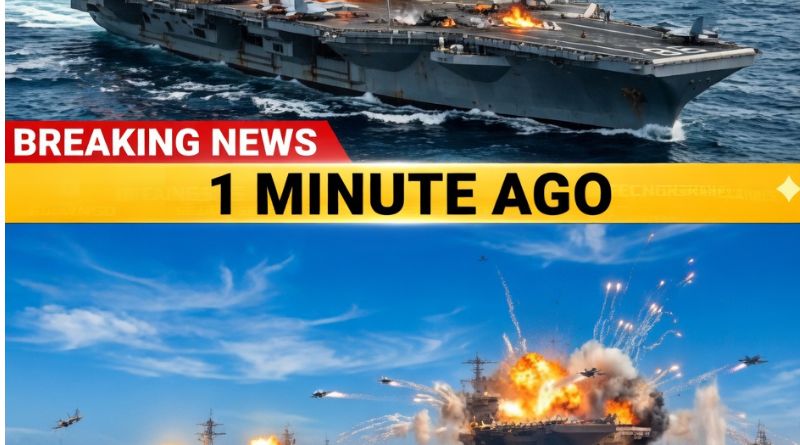
Just after sunrise, tension rose sharply in one of the world’s most sensitive maritime corridors when a U.S. carrier strike group operating near the Strait of Hormuz faced a sudden underwater threat. According to the scenario, three Iranian diesel-electric submarines moved quietly through outer surveillance zones and launched torpedoes toward an American aircraft carrier, one of the largest and most heavily protected warships in the world. The attack immediately triggered a full defensive response aboard the carrier and its escort ships.
The Strait of Hormuz remains strategically critical because a major portion of global oil shipments passes through its narrow waters each day. Any military confrontation there quickly attracts worldwide attention because even limited disruption can affect energy markets and regional stability. Iran has spent years strengthening submarine capabilities designed specifically for operations in shallow coastal waters. Smaller vessels such as the Ghadir-class submarine and larger Fateh-class submarine are built to exploit difficult underwater terrain, move quietly, and challenge larger naval forces through surprise rather than direct firepower. Once the torpedoes were detected, sonar teams aboard the U.S. ships began immediate threat analysis. Modern sonar operators are trained to separate hostile acoustic signals from heavy background noise caused by shipping traffic, sea conditions, and marine activity. In a narrow waterway, that task becomes even more difficult because sound travels unpredictably. Within moments, defensive systems were activated. Acoustic decoys were deployed into the water to create false sound signatures that could attract incoming torpedoes away from the carrier. These systems are designed to imitate the acoustic profile of a large ship, forcing enemy weapons to track the wrong target. At the same time, escort vessels increased anti-submarine monitoring while the strike group shifted formation to reduce vulnerability. A carrier never operates alone; surrounding destroyers and support ships form multiple defensive layers intended to detect and neutralize underwater threats before they reach the main vessel.
Air support quickly followed. Sikorsky MH-60R Seahawk helicopters lifted from nearby ships carrying sonar equipment and Mark 54 lightweight torpedo weapons. These aircraft are central to modern anti-submarine warfare because they can rapidly search wide areas and respond faster than surface ships alone. The incident reflects a growing concern in naval strategy: smaller submarines remain one of the few systems capable of threatening major surface fleets. Even advanced carriers rely heavily on layered protection because underwater attacks leave very little reaction time. Military planners often describe such confrontations as asymmetric warfare, where smaller forces seek advantage through stealth, timing, and geography rather than direct confrontation. Although aircraft carriers remain among the most protected military assets ever built, no ship is considered untouchable. Events like this continue to shape naval doctrine, especially in contested waterways where regional tension remains high. The broader lesson is clear: in modern maritime conflict, technology matters, but discipline, detection speed, and coordinated response often decide the outcome 🚢⚓🌍