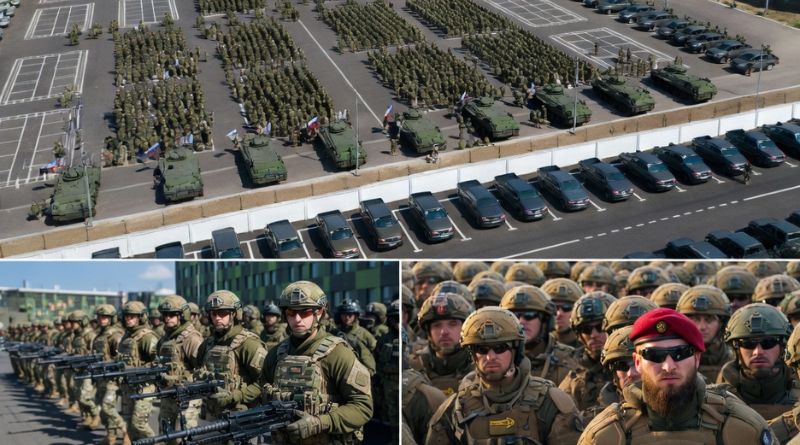
Iranian state media, particularly PressTV, has amplified a provocative claim: combat units loyal to Chechen leader Ramzan Kadyrov are prepared to deploy to Iran and wage a “holy jihad” should the United States launch a ground invasion. According to the report, these fighters frame any potential intervention as a sacred battle of good versus evil, positioning themselves as defenders of the Islamic Republic against American and allied forces. A spokesman in the circulated video clip asserted that the units stand ready to join Iranian troops shoulder-to-shoulder in what they describe as resistance to U.S. power.
This announcement surfaces amid heightened tensions in the Middle East. The United States, under President Donald Trump, has conducted a significant military buildup in the region, including aircraft carriers, destroyers, and additional troop deployments. These moves aim to deter Iranian threats, safeguard American interests, protect energy security, and counter destabilizing actions by Tehran and its proxies. The context includes ongoing U.S.-Israeli operations involving airstrikes and other measures against Iranian targets, following escalations tied to Iran’s nuclear activities, regional aggression, and internal unrest.
However, the Iranian media report relies on unnamed sources and lacks any independent verification from Russian or Chechen authorities. No official confirmation has emerged from Moscow or Grozny endorsing such a deployment. Analysts and observers widely view the claim as classic Iranian propaganda, intended to project strength, deter potential U.S. escalation, and internationalize the conflict by invoking Russia’s orbit. Similar unverified signals have appeared before, including statements from Chechen commanders like Apti Alaudinov offering weapons or personal readiness, but these remain conditional on Kremlin approval and have not translated into action.
Skepticism is warranted for several practical reasons. Russia remains deeply committed to its grinding war in Ukraine, where it has suffered enormous casualties over years of conflict with limited territorial gains despite committing substantial resources. Chechen units, often deployed as shock troops in urban fighting, have sustained heavy losses in that theater as well. Redirecting battle-hardened fighters halfway across the world—through contested logistics routes vulnerable to interdiction—would strain Moscow’s already stretched capabilities. Transporting and sustaining such forces in a theater dominated by superior U.S. air and naval power presents formidable challenges.
Even if a deployment materialized, the military mismatch would be stark. American forces possess overwhelming advantages in air dominance, precision-guided munitions, intelligence, surveillance, and reconnaissance. Assets like A-10 Warthogs for close air support, Apache helicopters, drones, and long-range strike capabilities could rapidly disrupt any convoy or reinforcement effort, echoing past operations where massed ground movements were decimated from the air. A ground war in Iran’s rugged terrain would be costly and complex for any invader, but introducing foreign jihadist-style irregulars would likely complicate matters more for the defenders than for a technologically superior opponent.
This rhetoric appears more as bluster than a credible threat. Both Iran and its backers project an image of unified global resistance, yet the reality reveals overextension and desperation. Russia, focused on Europe, has limited appetite for opening a major new front that could provoke direct confrontation with the West. Chechen loyalty to Kadyrov and Putin is well-documented in the Ukrainian context, but volunteering for a distant “jihad” against the U.S. military machine carries enormous risks with minimal strategic upside for Moscow.
Under resolute American leadership, the United States has historically refused to yield to jihadist threats or their state enablers. The U.S. military’s track record demonstrates the ability to project power decisively when core interests—protecting citizens, securing vital sea lanes and energy resources, and maintaining deterrence—are at stake. Threats of this nature, while noted, do little to alter strategic calculations. They may serve domestic propaganda purposes in Tehran or signal solidarity within the Russia-Iran axis, but they do not change the balance of power.
In the end, such declarations highlight the fragile alliances and information warfare surrounding the current standoff. A ground invasion of Iran would represent a major escalation with unpredictable consequences for the region and beyond. Yet dismissing bluster as substance would be a mistake only if it influenced policy. America’s conventional superiority, combined with careful calibration of objectives, ensures that any real challenge would be met with overwhelming response. The U.S. armed forces are prepared for contingencies; empty vows of holy war change little on the battlefield.