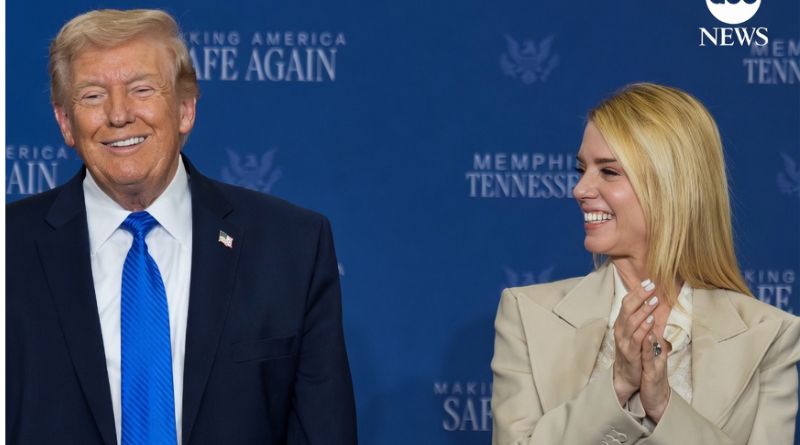
President Donald Trump announced Thursday that he has removed Pam Bondi as attorney general, ending a tumultuous 14-month tenure marked by deep divisions over the Justice Department’s direction and its alignment with the White House.
Trump praised Bondi in a statement as “a Great American Patriot and a loyal friend” who “faithfully served” in the role. He indicated she would transition to “a much needed and important new job in the private sector,” with details to be announced soon. The president named Deputy Attorney General Todd Blanche — one of his former personal lawyers — as acting attorney general. Sources familiar with the discussions told reporters that Trump has privately considered EPA Administrator Lee Zeldin as a potential permanent replacement.
Bondi, who entered office pledging to keep politics out of the Justice Department, faced mounting criticism from both sides of the aisle. Her departure follows months of internal frustrations, particularly over the handling of files related to the Jeffrey Epstein sex trafficking case and the pace of investigations into individuals perceived as Trump’s political adversaries.
In her statement, Bondi described the position as “the honor of a lifetime” and said she would spend the coming weeks ensuring a smooth transition to Blanche.
A Shift in DOJ Culture
Bondi assumed the role in early 2025 as Trump’s second choice after former Rep. Matt Gaetz withdrew amid controversy. A longtime Trump ally who had defended him during his first impeachment trial, she quickly became one of his most visible public supporters. Unlike previous attorneys general who emphasized independence from the White House, Bondi openly aligned herself with the president. She heaped praise on him during congressional hearings, defended his record, and even placed a banner featuring his image on the exterior of the Justice Department headquarters.
Critics, including Democrats like Sen. Adam Schiff of California, accused her of overseeing an “unprecedented weaponization” of the department that undermined the rule of law. They pointed to large-scale firings of career prosecutors and staff, the opening of investigations into Trump’s perceived enemies, and a sharp exodus of hundreds of employees — including those involved in Jan. 6 prosecutions, civil rights enforcement, and counterterrorism work.
Bondi’s defenders countered that she was correcting what they saw as politicization under the previous Biden administration, which had brought two federal cases against Trump. They argued she refocused the department on priorities like illegal immigration and violent crime while restoring credibility among conservatives who felt unfairly targeted in prior years.
Her public posture, however, broke longstanding norms. Bondi called for ending the “weaponization” of law enforcement she attributed to Biden-era officials, even as former Attorney General Merrick Garland and special counsel Jack Smith maintained their decisions were driven by evidence and law. At a February House Judiciary Committee hearing, she delivered a combative performance, trading insults with Democratic lawmakers, touting the stock market’s performance under Trump, and portraying the president as a victim of past investigations.
Even some Republicans grew uneasy. Last month, the GOP-led House Oversight Committee issued a subpoena for Bondi to appear in a closed-door interview regarding the Epstein files.
Investigations and Setbacks
Under Bondi, the Justice Department launched probes into several high-profile figures viewed as Trump opponents, including Federal Reserve Chair Jerome Powell, New York Attorney General Letitia James, former FBI Director James Comey, and former CIA Director John Brennan. Several cases, including prosecutions of Comey and James, were dismissed by judges who ruled the appointments of certain prosecutors improper.
Trump publicly defended Bondi but privately expressed impatience when the department failed to deliver swift results against his rivals. In one notable social media post, he urged faster action, warning that delays were damaging credibility.
Epstein Files Controversy
Much of the scrutiny centered on the department’s management of Jeffrey Epstein-related documents. Bondi had fueled public interest by suggesting in a 2025 Fox News interview that an Epstein “client list” sat on her desk awaiting review — a claim the department later walked back, acknowledging no such singular document existed.
She faced ridicule after distributing binders of Epstein files to conservative influencers at the White House, only for the materials to contain no significant new revelations. Despite repeated promises of transparency, the Justice Department announced in July that no further files would be released, prompting Congress to pass legislation forcing disclosure. The releases that followed — millions of pages — did little to quell criticism or conspiracy theories.
The missteps drew rare public rebuke from White House Chief of Staff Susie Wiles, a longtime Bondi friend, who told Vanity Fair that the attorney general had “completely whiffed.” A House committee, with support from five Republicans, subpoenaed Bondi to testify under oath.
Bondi’s tenure coincided with significant turnover at the department, including the departure of prosecutors involved in cases related to the January 6, 2021, Capitol attack, environmental and ethics enforcers, and others. Supporters viewed these changes as necessary reform; detractors saw them as an effort to reshape the agency in the president’s image.
As Blanche steps in as acting leader, questions remain about the future direction of the Justice Department and whether a permanent nominee can restore stability amid ongoing partisan tensions. The move underscores the challenges of balancing loyalty to the president with the department’s traditional independence in a deeply polarized environment.