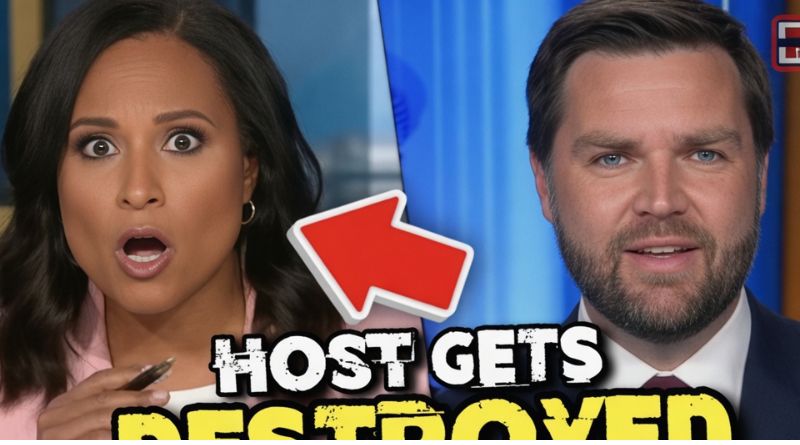
Republican vice presidential nominee J.D. Vance sharply pushed back against NBC News host Kristen Welker during a tense July 7, 2024, interview on Meet the Press. Welker repeatedly pressed Vance on whether he would support Donald Trump appointing a special prosecutor to investigate Joe Biden and his family if Trump won the election.
Welker framed Trump’s comments as a plan to “go after his political enemies, the Bidens.” Vance rejected that characterization as overblown and accused the media and Democrats of losing perspective. He argued that Trump was simply calling for a legitimate investigation into potential wrongdoing by the prior administration, not political retaliation.
“Donald Trump is talking about appointing a special prosecutor to investigate Joe Biden for wrongdoing,” Vance said. He pointed to House Oversight Committee findings that documented over $20 million in foreign payments to Biden family members and associates from sources in China, Ukraine, Russia, Romania, and elsewhere. Republicans highlighted shell companies, influence-peddling allegations, and Joe Biden’s interactions with some of those associates, though no criminal charges were brought against the president himself.
Vance contrasted this with what he called the Biden administration’s “campaign of lawfare” against Trump. He noted that Attorney General Merrick Garland, appointed and removable by Biden, oversaw special counsels investigating Trump. Vance also highlighted the move of Matthew Colangelo—a senior Justice Department official under Biden (often described as high-ranking, including acting associate attorney general)—who left the DOJ in late 2022 to join Manhattan DA Alvin Bragg’s office and became a lead prosecutor in Trump’s New York hush-money case.
Vance called the Colangelo transfer unusual and unprecedented in scale for targeting a leading political opponent. The DOJ later stated it found no improper communications or coordination between federal officials and Bragg’s team regarding the case. Welker countered that prosecutors often move between government levels and that Trump’s indictments came from grand juries, with the New York conviction delivered by a jury of peers.
Vance refused to accept the premise. “I would absolutely support investigating prior wrongdoing by our government,” he said. “That’s what you have to have in a system of law and order.” He argued that if a top official from a Trump administration had joined a local prosecutor to target Biden, it would be viewed as outrageous. He added that the recent Supreme Court immunity ruling (Trump v. United States, July 1, 2024) cast doubt on aspects of the New York prosecution involving official acts, though New York courts later rejected immunity-based efforts to overturn the conviction.
Welker pressed Vance to clarify whether he saw a double standard. Vance maintained that Trump’s proposal was not about weaponizing justice but restoring accountability after what Republicans viewed as selective enforcement. “All he’s suggesting is that we should investigate credible arguments of wrongdoing,” Vance concluded. “That is not a threat to democracy. That’s merely reinforcing our system of law and government.”
The exchange highlighted deep partisan divides over the justice system’s perceived fairness. Conservatives praised Vance for refusing the “gotcha” framing, while critics accused him of endorsing retaliatory prosecutions. The clash underscored ongoing debates about two-tiered justice and the boundaries of accountability versus political retribution in American democracy.