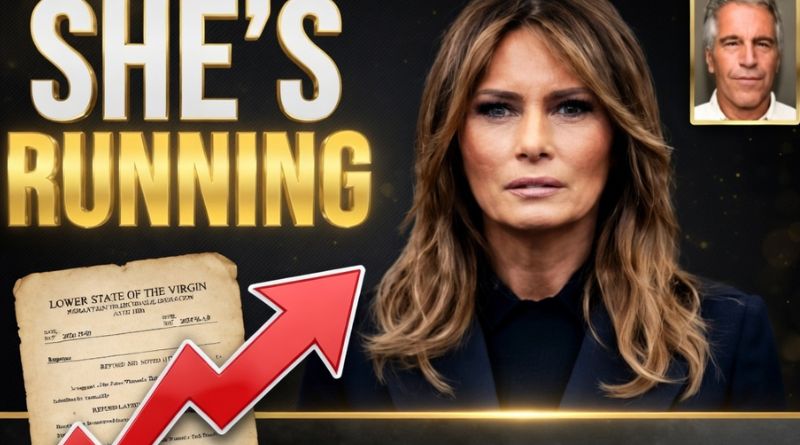
The scene outside the White House carried an unusual air of anticipation on Thursday, April 9, 2026, as First Lady Melania Trump stepped forward in a rare public appearance. Security details remained tight, and media crews gathered swiftly in the Grand Foyer. What unfolded was not a routine briefing but a carefully prepared statement that thrust Melania Trump into the center of a long-simmering controversy involving Jeffrey Epstein.
Her remarks marked a notable shift. For years, the former First Lady has maintained a composed distance from political scandals and legal entanglements, preferring privacy and restraint. On this day, however, she directly confronted persistent allegations linking her name to the convicted sex offender. Reading from a prepared text, Melania Trump declared, “The lies linking me with the disgraceful Jeffrey Epstein need to end today.” She described accusations as “smears” and “baseless lies,” motivated by financial or political gain, and emphasized that she had never been friends with Epstein or his associate Ghislaine Maxwell.
Melania clarified that any social overlaps occurred because she and her husband occasionally attended the same New York and Palm Beach events where Epstein was present—a common occurrence in those circles. She specifically addressed a 2002 email exchange with Maxwell, calling it nothing more than “casual correspondence” or a “trivial note.” Crucially, she stated she had no knowledge of Epstein’s crimes, was never on his plane, never visited his island, and was “not Epstein’s victim.” Epstein did not introduce her to Donald Trump, she added; the couple met by chance at a New York party in 1998.
The statement went beyond denial. In a surprising move, Melania called on Congress to hold public hearings centered on Epstein’s survivors. She urged lawmakers to allow victims to testify under oath, with their accounts permanently entered into the Congressional Record. “Only then will we have the truth,” she said. The address lasted less than six minutes. After delivering it, she walked out without taking questions, even as one reporter shouted, “Why now?”
Legal observers noted that the timing coincides with ongoing civil litigation. Author Michael Wolff sued Melania Trump after she threatened a massive defamation action—reportedly seeking over $1 billion—over his public comments about her alleged social ties to Epstein’s circle. Melania’s team has moved to dismiss the suit, challenged jurisdiction and service, and argued over venue, often seeking to shift proceedings toward Florida. While the case remains procedural and grinding, it has kept Epstein-related speculation alive in media and online circles. No criminal charges have ever been filed against Melania Trump in connection with Epstein.
Throughout her public life, Melania has cultivated an image of elegance and measured reserve. She has rarely addressed controversies head-on, focusing instead on initiatives like child welfare, anti-bullying efforts, and more recently, the “Take It Down Act” targeting non-consensual intimate imagery. Her White House appearance broke that pattern, drawing intense global coverage and intensifying online discussions.
Communications experts suggested the deliberate brevity and lack of Q&A reflected a strategic choice: confront the narrative on her own terms without feeding the rapid news cycle. Supporters viewed the statement as a firm defense of her reputation, while critics questioned the sudden visibility and speculated on internal White House dynamics. President Trump reportedly had no prior knowledge of the exact timing, according to some reports.
As the day progressed, news outlets shifted to live analysis, and social media buzzed with reactions ranging from praise for her poise to renewed scrutiny of past photos and documents. The event underscored the enduring power of the Epstein saga to intersect law, politics, and public perception—even for figures who have tried to remain on the periphery.
In the end, Melania Trump’s rare intervention did not close the chapter but reframed it. By denying any meaningful connection and advocating for victims’ voices, she transformed a defensive posture into a call for transparency. The broader narrative continues to evolve through courts and potential congressional action, illustrating how quickly attention can refocus when prominent names enter the conversation around one of the most notorious scandals in recent memory.