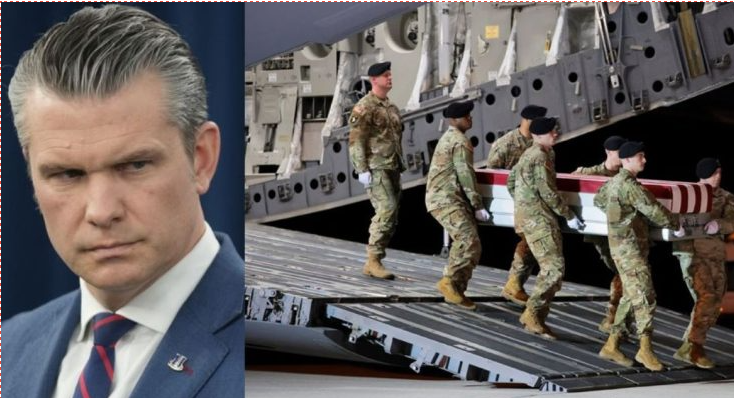
Survivors of a deadly Iranian drone strike on a U.S. military facility in Kuwait are challenging the Pentagon’s account of the March 1, 2026, attack, which killed six American service members and wounded more than 20 others.
The strike hit a tactical operations center — a converted trailer used by troops from the Army’s 103rd Sustainment Command — at Port Shuaiba, a smaller outpost south of Kuwait City. It marked the deadliest attack on U.S. forces in the early stages of Operation Epic Fury, the U.S.-Israeli campaign against Iran that began in late February 2026.
In interviews with CBS News, survivors disputed Defense Secretary Pete Hegseth’s description of the incident. Hegseth had called the drone a “squirter” — military slang for a threat that slips through defenses — that struck a “fortified” position. One injured soldier rejected that framing outright: “Painting a picture that ‘one squeaked through’ is a falsehood. I want people to know the unit was unprepared to provide any defense for itself. It was not a fortified position.”
Troops described the site as minimally protected, relying mainly on thin vertical blast barricades with no effective overhead cover against drones or missiles. “From a bunker standpoint, that’s about as weak as one gets,” one said. When asked about the level of fortification, he replied, “I would put it in the none category.” Drone defense capabilities at the location were similarly described as nonexistent.
Survivors also questioned the decision to relocate their unit closer to Iran, to an area they viewed as a known target. “We moved closer to Iran, to a deeply unsafe area,” one told CBS. “I don’t think there was a good reason ever articulated.”
Pentagon officials, including spokesman Sean Parnell, maintained that measures had been taken to protect troops and described the facility as a secure tactical operations center with 6-foot walls. Hegseth noted the power of Iranian weapons and the challenges of air defense in the region.
The discrepancy highlights tensions between on-the-ground experiences and higher-level assessments. In the fog of rapid deployments during the opening phase of conflict, force protection can vary significantly between forward logistics sites and main bases. The 103rd Sustainment Command troops, primarily Army Reservists focused on logistics support, were operating from a port facility rather than a hardened combat outpost.
This incident has fueled debate over preparedness in the early days of the Iran campaign. Critics argue the administration underestimated Iranian retaliation capabilities. Supporters point to the broader strategic context: years of Iranian proxy attacks, missile threats, and nuclear concerns that prompted the operation, which the White House says achieved key objectives before a recent ceasefire tied to Strait of Hormuz access.
Six American lives lost in service is a grave loss that demands thorough review. Survivors’ accounts deserve serious attention through formal after-action investigations and congressional oversight, rather than immediate politicization. Wars involve imperfect intelligence, resource constraints, and adversary adaptations — especially against drone swarms. Accountability for any lapses in local protection should be pursued factually, separate from larger policy disagreements over engaging Iran.
The troops’ frustration is understandable. Transparent accounting honors their sacrifice and helps prevent future vulnerabilities, regardless of the high-level narrative.