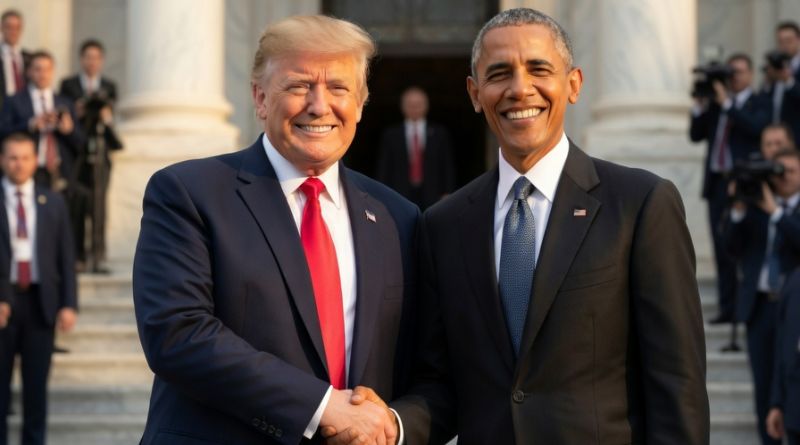
A recent exchange between former President Barack Obama and President Donald Trump rapidly evolved into one of the most talked-about political moments of early 2026. What began as a casual podcast interview quickly sparked sharp criticism and a rapid back-and-forth that dominated television coverage and social media feeds.
The spark came during Obama’s sit-down with YouTuber Brian Tyler Cohen in mid-February. In a lighthearted lightning-round segment, Obama was asked if aliens are real. He replied casually that they are, but added he had seen no evidence of them being hidden at Area 51 or in underground facilities during his time in office. Clips of the remark spread quickly, prompting Trump to respond days later while speaking to reporters aboard Air Force One.
Trump sharply criticized Obama, accusing him of revealing “classified information” and making a “big mistake.” “He’s not supposed to be doing that,” Trump said. “He took it out of classified information.” When pressed on whether he believed aliens exist, Trump replied that he did not know but suggested he might declassify related files to “get [Obama] out of trouble.” The exchange highlighted the lingering tensions between the two figures, even years after Obama left office.
Reactions poured in almost immediately, splitting largely along partisan lines. Trump’s supporters viewed the response as classic straight talk—calling out what they saw as a breach of protocol by a predecessor. Critics, meanwhile, dismissed it as another example of unnecessary escalation and personal attacks that contribute to the coarsening of political discourse. Some observers noted the irony: a light alien question had turned into accusations of mishandling sensitive material.
Yet the episode revealed far more than just policy differences or personal jabs. It underscored how modern media—live television, short-form video clips, and instant social sharing—transforms isolated moments into nationwide controversies within minutes. Full context from the original podcast often got lost as dramatic soundbites and facial expressions circulated faster than the complete conversation.
This shift has profound implications. In today’s environment, political leaders are judged not only by their records or proposals but by how they perform in spontaneous, high-pressure settings and how those performances are amplified (or distorted) online. Algorithms reward emotion and brevity, often at the expense of nuance. A single remark about extraterrestrial life, or a pointed rebuttal to it, can dominate the news cycle and shape public narratives more powerfully than extended policy discussions.
In the end, the Trump-Obama exchange on aliens served as a microcosm of broader trends. It demonstrated how quickly perceptions form around fragments rather than substance, and how intertwined live media and digital platforms have become in shaping political reality. Whether one sees such moments as refreshing candor or troubling incivility, they reflect a media landscape that increasingly favors virality over depth. As politics continues to unfold in real time across screens, these fleeting interactions may increasingly define how history remembers them.