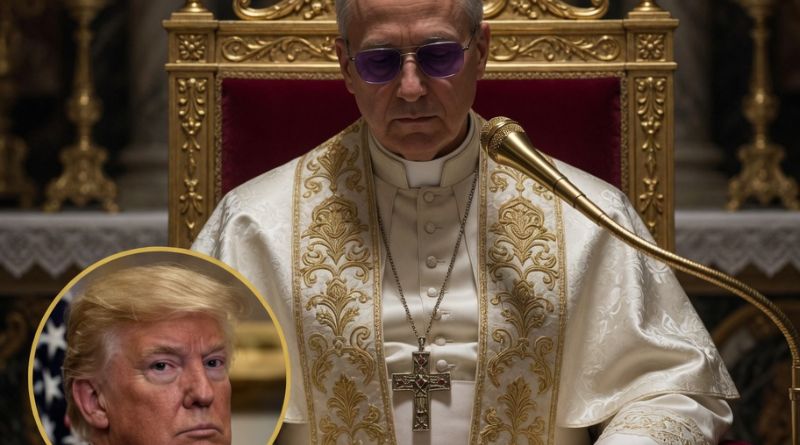
In a world steeped in centuries-old tradition, where every gesture and syllable from the Vatican is scrutinized, a single moment can captivate global attention. Just days after his election in May 2025 as the first American-born pope, Pope Leo XIV—formerly Cardinal Robert Francis Prevost, a Chicago native with decades of missionary work in Peru—delivered such a moment.
During an early Vatican encounter with journalists, NewsNation correspondent Robert Sherman asked the pontiff a question many Americans were eager to hear: “Do you have a message for the United States?”
Pope Leo XIV paused briefly, offered a calm smile, and replied with one deliberate word: “Many.”
He added a traditional blessing—“God bless you all”—and continued as if the exchange were unremarkable. Yet that single syllable exploded across social media and international headlines within minutes, sparking widespread analysis, speculation, and debate.
In an era of lengthy, scripted statements and endless commentary, the brevity of Pope Leo XIV’s response struck many as refreshingly bold and modern. Commentators praised it as thoughtful restraint and a mark of wisdom. Others viewed it as an intentional invitation for reflection, rather than a prescriptive declaration. The word’s ambiguity allowed listeners to project their own perspectives onto it.
To some, “Many” acknowledged the United States’ numerous strengths: its economic power, cultural influence, innovative spirit, and global responsibilities. To others, it subtly highlighted the country’s many challenges—social divisions, political polarization, economic pressures, and moral questions on issues like immigration, peace, and justice. Given the pope’s background in humanitarian aid, education, and interfaith dialogue, the response aligned with his emphasis on compassion and open conversation rather than judgment.
The genius of the single-word reply lies in its economy. By saying so little, Pope Leo XIV created space for active interpretation. He avoided dictating a viewpoint, instead encouraging audiences to consider the broader context of America’s role in the world—its potential for good, its complexities, and its ethical obligations. Scholars noted that this approach echoes the pontiff’s long-standing commitment to dialogue over dogma.
The moment also underscored the papacy’s evolution in the digital age. A brief response, captured on video, spread virally across platforms, reaching millions and turning passive observers into participants in meaning-making. In a flood of information, brevity cut through the noise, fostering engagement far beyond Vatican walls.
This episode illustrates a timeless truth about communication: restraint often carries greater power than verbosity. In a culture prone to over-explaining, a single well-chosen word can prompt deeper thought, invite dialogue, and inspire curiosity. Pope Leo XIV demonstrated that leaders need not dominate conversations with volume; thoughtful minimalism can resonate more profoundly.
For modern leadership, the lesson is clear. Influence stems not from the quantity of words but from their clarity, intention, and resonance. “Many” served as both statement and mirror, reflecting back the audience’s own hopes, concerns, and responsibilities. It encouraged collective reflection on values like unity, justice, and global solidarity—hallmarks of the new pontificate.
Ultimately, this hypothetical-turned-real scenario reveals how even ancient institutions can thrive in a fast-paced, interconnected world. Through precision and intentional silence, Pope Leo XIV showed that sometimes the quietest words carry the greatest weight. They leave room for interpretation, spark genuine conversation, and connect leaders to diverse audiences in ways elaborate speeches rarely achieve.
In an age of constant noise, brevity paired with purpose reminds us that one word—delivered with calm conviction—can shift the global discourse and invite humanity to ponder its shared path forward.