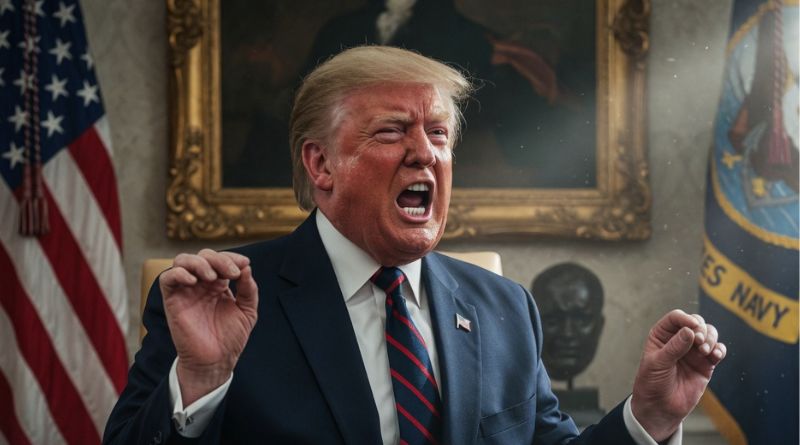
A Wall Street Journal report has detailed tense moments inside the Trump administration during a high-stakes military incident in the ongoing U.S.-Iran conflict. According to the article, when an American F-15E Strike Eagle was shot down over Iran on April 3, 2026, with two airmen missing, President Donald Trump reacted with intense frustration, screaming at aides for hours.
Senior officials told the WSJ that Trump demanded immediate action to rescue the pilots, expressing concerns about the political fallout. He reportedly referenced the failed 1980 Iran hostage rescue under President Jimmy Carter, which damaged Carter’s re-election bid. “If you look at what happened with Jimmy Carter… with the helicopters and the hostages, it cost them the election,” Trump had said earlier in March. “What a mess.”
Aides, concerned that the president’s impatience could complicate real-time operational decisions, limited his direct involvement in the Situation Room. They provided updates at key intervals by phone instead, while senior officials including Vice President JD Vance and Chief of Staff Susie Wiles monitored developments. One senior administration official said they believed his presence would not be helpful during the delicate phase.
The rescues ultimately succeeded. One airman was recovered quickly. The second evaded capture for more than 24 hours deep in Iranian territory before U.S. special operations forces conducted a high-risk extraction. Trump publicly praised the missions as “one of the most daring search and rescue operations in U.S. history,” stating he had monitored them closely alongside Defense Secretary Pete Hegseth and Joint Chiefs Chairman Dan Caine. He posted “WE GOT HIM!” after the second rescue and emphasized that the U.S. never leaves personnel behind.
Hours after the successful recovery, on Easter Sunday, Trump posted a profanity-laced message on Truth Social directed at Iran over disruptions in the Strait of Hormuz, a critical global oil route. The post demanded Iran reopen the strait, warning of strikes on power plants and bridges if it did not comply by a Tuesday deadline. It concluded with the phrase “Praise be to Allah. President DONALD J. TRUMP.”
Trump later explained aspects of his rhetoric as intentional unpredictability aimed at pressuring Tehran toward negotiations. He also issued a broader warning, stating “a whole civilization will die tonight” if Iran failed to reach a deal—language that drew sharp backlash. Former Rep. Marjorie Taylor Greene called the statement “evil and madness” and urged invocation of the 25th Amendment. Some Democratic lawmakers introduced symbolic legislation supporting the same step, though it faces long odds in a Republican-controlled Congress.
White House Press Secretary Karoline Leavitt pushed back against portrayals of dysfunction, stating that Trump “remained a steady leader our country needs.” The administration has framed the tough rhetoric and military actions as necessary to counter Iranian aggression, reopen the strait, and advance negotiations, which continue amid a fragile ceasefire.
The WSJ piece highlights the challenges of Trump’s impulsive, high-pressure style in a live combat scenario. Critics see evidence of erratic decision-making and excessive focus on political optics. Supporters argue it reflects his longstanding “maximum pressure” approach—blending threats with deal-making—that has forced concessions before, including in his first term with Iran. The rescues averted a potential prolonged hostage situation, and the U.S. maintained operational control despite the shootdown.
This episode occurs against the backdrop of broader U.S.-Israeli strikes on Iranian targets, Iranian responses, and efforts to prevent Tehran from advancing its nuclear program or dominating regional shipping lanes. Oil markets and global energy security remain sensitive to developments in the Strait of Hormuz.
Presidents have long faced intense stress during military crises, with internal debates and leaks common across administrations. How one interprets the reported friction—whether as unfitness or the messy reality of high-stakes leadership—often tracks with prior views of Trump. The underlying facts show successful rescues, continued diplomacy, and no loss of American personnel to capture, even as rhetorical escalation continues. The incident underscores the real risks of escalation in the Middle East while testing the limits of personal leadership style in wartime.