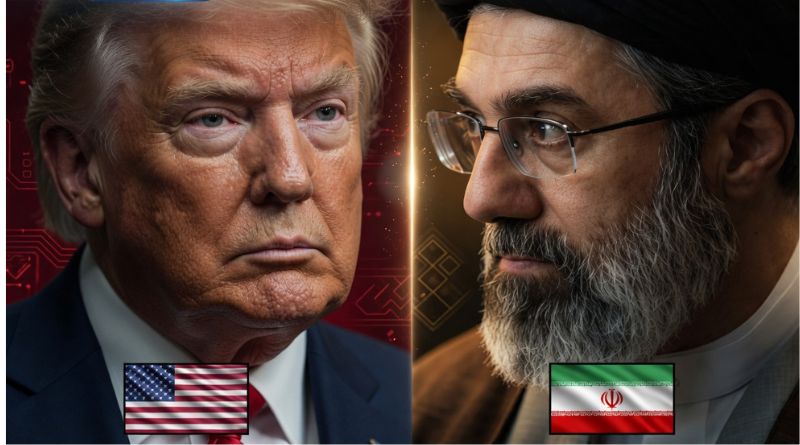
Following recent provocative remarks by U.S. President Donald Trump, Iran has issued a firm and uncompromising warning that marks a potentially dangerous shift in the already volatile dynamics of the ongoing Middle East conflict. Iranian officials have explicitly drawn a “red line” around the country’s power plants and broader energy infrastructure, declaring that any direct attack on these facilities would provoke immediate and proportionate retaliation. This stance represents a notable evolution in Tehran’s posture. While Iran has previously shown some restraint in avoiding purely civilian and industrial targets, senior figures now signal that such limitations may no longer apply if the nation’s critical energy grid comes under threat. The message serves both as a deterrent and as a clear redefinition of acceptable boundaries in a fragile regional environment marked by active hostilities, ceasefires under strain, and repeated ultimatums.
The escalation stems from Trump’s repeated threats, often delivered in blunt, expletive-laden posts on Truth Social, to target Iranian power plants, bridges, oil facilities, and even desalination plants if Iran fails to fully reopen the Strait of Hormuz to international shipping. Trump has set and extended multiple deadlines—most recently framing certain days as “Power Plant Day” or warning that “a whole civilization will die tonight” without a deal—using the pressure to force compliance, restore global energy flows, and advance negotiations. Iran, which has effectively restricted or controlled traffic through the strait (a chokepoint carrying roughly 20% of the world’s oil) since the conflict intensified in late February 2026, has responded defiantly. Officials have vowed to respond “in kind,” threatening to strike energy and water infrastructure across the Gulf region and to keep the strait closed indefinitely until damaged facilities are rebuilt.
This rhetorical and strategic tit-for-tat heightens fears of dangerous miscalculations. With both sides testing limits through public statements, proxy actions, and military posturing, even a limited incident could spiral into wider confrontation. Tehran’s warning underscores the humanitarian stakes involved in targeting energy systems. Widespread blackouts could rapidly disrupt hospitals, water treatment plants, emergency services, and food supply chains, inflicting suffering on civilian populations far beyond any military objectives. International observers and legal experts have raised concerns that large-scale strikes on such infrastructure risk violating principles of international humanitarian law, which generally protect civilian objects unless they provide a clear and immediate military advantage. Iran has amplified these risks in its messaging, framing potential U.S. or Israeli actions as not only aggressive but potentially amounting to collective punishment.
The implications extend well beyond the immediate region. The Middle East remains the heart of global energy production and maritime transport routes. Significant damage to Iran’s power grid or related facilities—or retaliatory strikes on Gulf energy assets—could trigger sharp spikes in oil and gas prices, disrupt international supply chains, and inject fresh uncertainty into already volatile markets. By highlighting these global consequences, Iranian officials appear intent on deterring attacks while broadening the perceived costs of escalation, positioning any strike on their energy sector as an action with worldwide economic and humanitarian fallout.
At the same time, competing narratives from Washington, Tehran, and other regional actors continue to justify potential military moves, complicating diplomatic initiatives. A fragile ceasefire has held in some areas since early April 2026, yet mutual distrust persists amid ongoing naval enforcement, mine threats in the strait, and sporadic strikes. Trump has cited progress in talks at times while renewing deadlines; Iran has rejected short-term pauses in favor of permanent resolutions that include sanctions relief and reconstruction guarantees. As sharp rhetoric persists, the delicate balance between deterrence, civilian protection, and global economic stability grows ever more precarious.
Analysts warn that misjudgments in this high-stakes environment could rapidly transform localized tensions into a broader conflict with unpredictable consequences. In the weeks ahead, the interplay of calibrated responses, backchannel diplomacy, and raw power projection will likely determine whether the region edges toward de-escalation or descends further into instability. The current trajectory serves as a stark reminder of how quickly words and red lines can reshape security realities—not only for the Middle East but for energy markets and international relations worldwide.