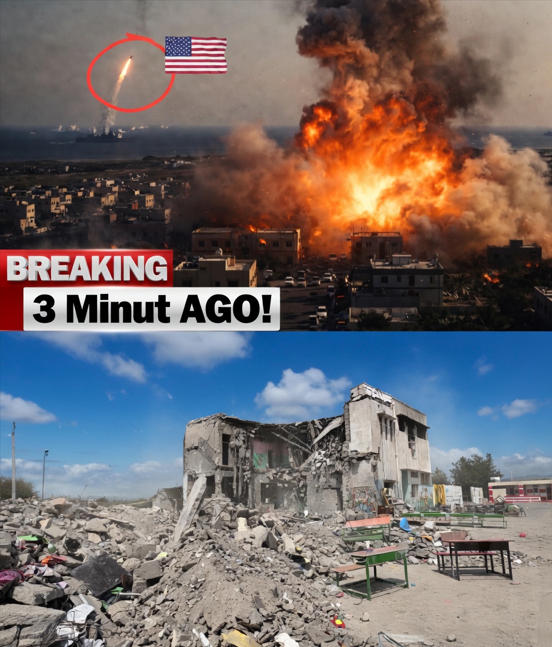
Newly released video footage is raising new questions about a deadly explosion at a school in the Iranian port city of Minab, an incident that occurred amid rising tensions between the United States and Iran. The blast, which reportedly struck near a compound linked to the Islamic Revolutionary Guard Corps (IRGC), has drawn international scrutiny after analysts suggested the weapon seen in the footage resembles a Tomahawk cruise missile, a long-range precision weapon commonly used by the U.S. military. Initial reports indicate the explosion damaged or destroyed a nearby school, raising concerns about possible civilian casualties. Witnesses in the area said the strike occurred during a period of heightened military activity, prompting questions about whether the school was intentionally targeted or was inadvertently caught in an attack aimed at nearby military infrastructure.
Military analysts reviewing the footage say the missile’s apparent shape and flight characteristics are consistent with those of a Tomahawk system, known for its accuracy and ability to strike distant targets with precision. However, experts caution that video evidence alone is not sufficient to conclusively determine the origin of the weapon. Officials have said the incident remains under investigation, with authorities examining additional video, satellite imagery, and other intelligence to establish what occurred. Determining responsibility could carry significant diplomatic consequences.
The explosion comes amid a prolonged period of geopolitical friction between Washington and Tehran, fueled by disputes over nuclear activity, regional security, and military operations across the Middle East. Any confirmed link between the strike and U.S. forces could further complicate already fragile relations. Public reaction has been intense, particularly on social media, where the incident has fueled debate over the risks of military operations conducted near civilian areas. As investigators continue to review the evidence, the tragedy in Minab highlights the persistent humanitarian risks associated with modern warfare and the importance of safeguarding civilian lives during armed conflict.