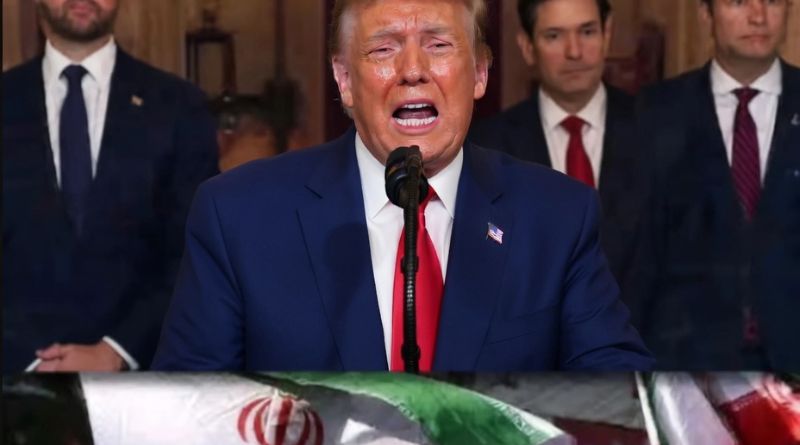
The latest confrontation involving Iran and the United States has intensified global concern after reports surrounding a major leadership crisis in Tehran. The confirmed death of Iran’s Supreme Leader has added a new layer of uncertainty to an already fragile geopolitical environment, prompting analysts to closely watch how Iranian leadership may respond in the coming days. For decades, relations between Washington and Tehran have been shaped by sanctions, military pressure, proxy conflicts, and repeated diplomatic breakdowns. Yet many observers say the current moment feels especially sensitive because leadership transition inside Iran often carries both domestic and international consequences.
In recent days, intelligence discussions have focused on whether Iranian military planners could consider retaliatory actions designed more for symbolism than large-scale destruction. Security experts note that in previous periods of tension, Iranian responses often relied on calibrated pressure rather than direct confrontation, but current rhetoric has drawn increased attention from defense agencies. According to emerging intelligence assessments, several signals—including intercepted communications and military movement reports—have prompted closer monitoring by Western security officials. While no public evidence confirms an imminent strike, authorities are examining scenarios involving long-range capabilities, cyber operations, and regional escalation. Analysts say any potential Iranian action would likely aim to demonstrate reach rather than trigger immediate full-scale war. One defense expert described such a possibility as an effort to create psychological impact by showing that distance alone no longer guarantees strategic protection. Possible targets discussed in security circles include symbolic political and economic centers. The corridor linking Washington, D.C. and New York City remains central in many threat models because of its political influence and global financial importance. At the same time, experts also point to the western United States. Installations in California and Washington are frequently mentioned because of their naval assets, satellite infrastructure, and military communications networks. Any disruption there could complicate rapid coordination during a crisis.
Energy infrastructure also remains a major concern. Strategic planners continue to evaluate how attacks affecting Gulf Coast facilities or major hubs in Texas could ripple through global fuel markets and domestic supply systems. The United States maintains advanced missile defense systems, including Aegis Combat System and Terminal High Altitude Area Defense, designed to intercept airborne threats. Still, military analysts caution that any complex multi-vector attack could place heavy demands on even sophisticated defense layers. Across the country, public anxiety has grown as online speculation spreads rapidly. Officials have urged caution against unverified claims while maintaining heightened readiness. 🇺🇸⚠️ The White House has reiterated that any direct attack would trigger a powerful response, emphasizing deterrence while avoiding language that could further inflame tensions. Whether this moment leads to escalation or restraint remains uncertain, but many experts agree it has already reminded the world how quickly modern security crises can evolve. 🌍🛰️