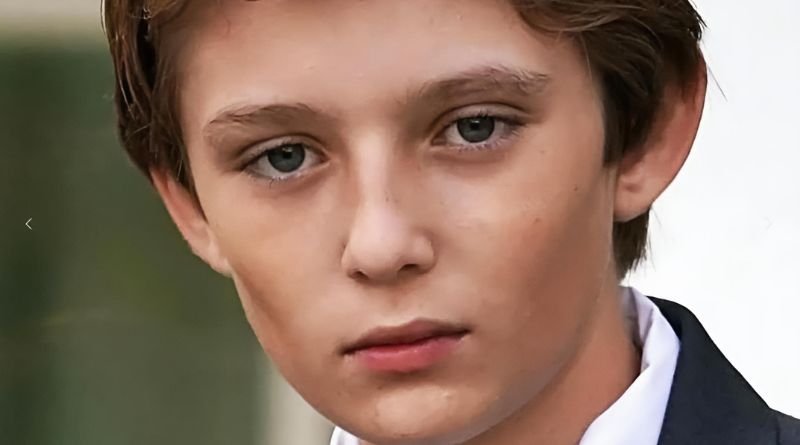
Born on March 20, 2006, in Manhattan, Barron Trump entered a world characterized by extreme wealth, political power, and a level of visibility that few could ever fully comprehend. While the Trump surname naturally invited intense public scrutiny and a barrage of assumptions from the moment of his birth, his upbringing was governed by a domestic philosophy of restraint and privacy. This foundational approach was primarily established by his mother, Melania Trump, who made a conscious decision to shield her son from the relentless media circus and political spectacles that defined his father, Donald Trump. In a household often recognized for its loud bravado and media dominance, Barron was taught that silence, discipline, and manners were far more valuable than the fleeting validation of public attention. Melania Trump’s parental strategy was a deliberate departure from the high-octane public image of the family brand. She focused on the “invisible work” of parenting, emphasizing routine and boundaries over the spotlight. From an early age, Barron was encouraged to stay grounded and focused on personal development rather than external accolades. Public observers frequently noted his tall, reserved presence at official functions, where he often stood stoically a step behind his parents. While many observers misread this quiet nature as aloofness or lack of engagement, it was, in reality, an intentional form of “armor.” Melania recognized early on that the world is rarely kind to the children of high-profile figures, and she worked tirelessly to prevent her son’s formative years from being reduced to a series of tabloid headlines.
Throughout the family’s tenure in the White House, Melania acted as a fierce protector of Barron’s privacy, setting boundaries that few parents in such a position have dared to draw. As the political climate grew increasingly polarized, even the youngest member of the family became a target for satire and unsolicited online commentary. Melania’s public interventions—reminding the press and the public that a minor child should be off-limits—established a rare boundary in contemporary American politics. During these years, Barron attended school with as much normalcy as his secret service detail allowed, focusing on his education and languages rather than the digital feedback loops that define his generation. He did not speak at political conventions, nor did he cultivate a social media presence, effectively preserving a sense of mystery that contrasted sharply with the rest of his family. As Barron transitions into adulthood, having recently turned eighteen, he remains a sharp contrast to the established Trump persona. While his siblings and father often lean into the media spotlight to shape public narratives, Barron has remained consistently observant and thoughtful. He has spent years watching the mechanics of power from the periphery, learning how to discern character and intent without feeling the need to be the center of the spectacle. Those close to him suggest that his confidence is entirely internal; he does not require a public audience or constant self-promotion to validate his identity. This quality makes him a unique anomaly in a modern culture that rewards loudness and performative behavior above all else.
Looking toward the future, Barron Trump holds the rare privilege of genuine choice. Whether his interests lead him toward business, technology, or a life completely outside the public eye, his path will likely be defined by deliberation rather than reaction. The insulation provided by his mother has allowed him to develop a steady temperament amidst the chaotic news cycles that have defined his family’s history. In the end, the most significant inheritance Barron may carry is not a financial one, but the lesson that not every thought belongs in the public sphere. In a family synonymous with spectacle, his steady, quiet presence and his commitment to privacy may eventually be seen as his most powerful and unexpected legacy.