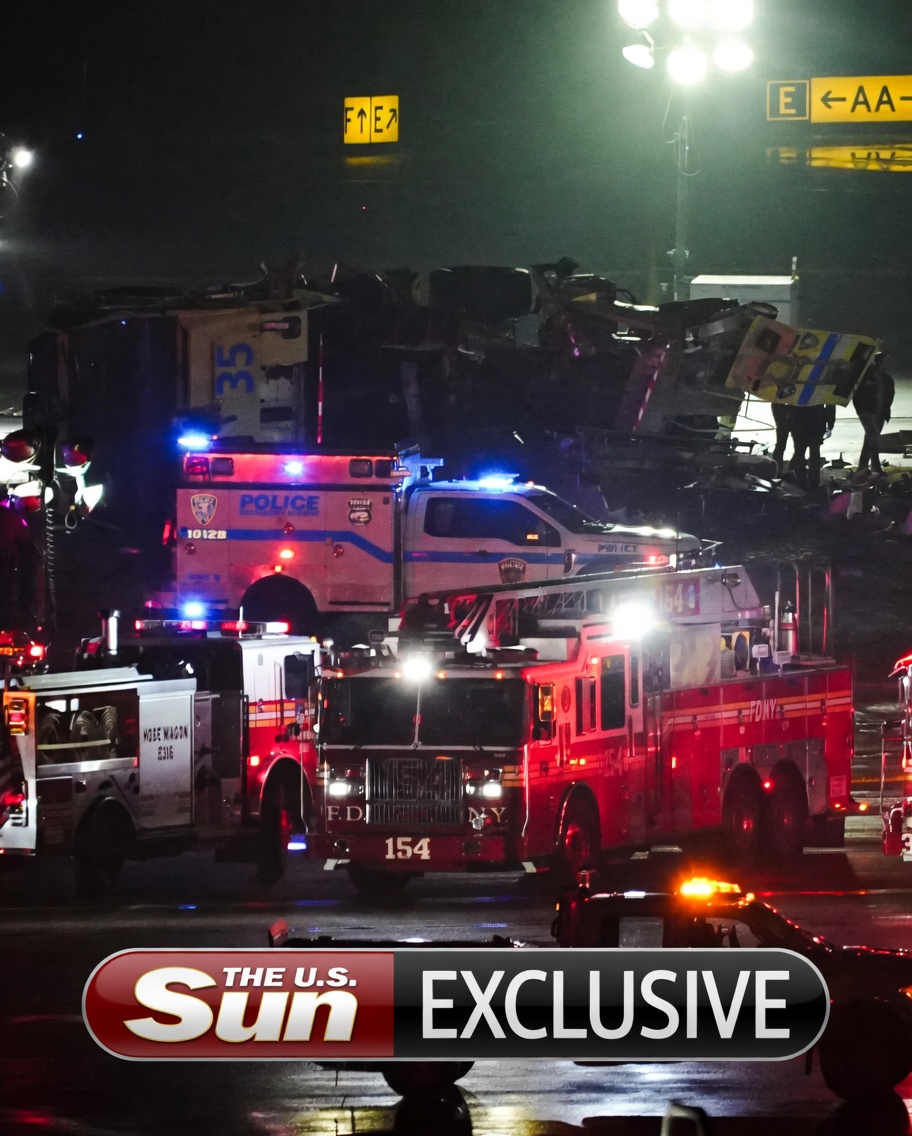
Questions are intensifying over runway safety procedures at New York’s LaGuardia Airport after a devastating collision between an airport fire vehicle and an arriving Air Canada aircraft left two pilots dead and dozens of passengers injured.
The accident occurred Sunday night when an emergency response vehicle operated by the Port Authority of New York and New Jersey entered an active runway while Air Canada Flight 8646 was landing after arriving from Montreal.
According to preliminary reports, the fire truck had been dispatched to assist with a separate aircraft issue involving United Airlines Flight 2384 after crew members reported a strange odor inside the cabin and requested emergency support. As responders rushed toward that aircraft, the truck was reportedly cleared to cross the middle section of the runway—just moments before the Air Canada jet touched down.
The timing proved catastrophic.
Aviation specialists say that while crossing through the center of the runway may have offered the quickest route, it also introduced extreme risk because an aircraft was already approaching at landing speed. One aviation expert now argues that the vehicle should have taken a longer route around the runway perimeter, even if that delayed the emergency response by several minutes.
Pilot and flight instructor David Evans said the decision raises serious questions about airport operating procedures during emergencies.
He explained that while some airport personnel may defend the shorter crossing, many pilots would strongly prefer that service vehicles only cross runways near the ends, where visibility and coordination are typically more predictable.
“In my view, if airport vehicles have to cross a runway, it is far safer when that happens near the runway ends,” Evans said. “That may not be universally accepted, but from a pilot’s perspective, it reduces risk during active aircraft movements.”
He added that investigators will likely focus not only on communications between the tower and the fire crew, but also on whether existing emergency protocols at the airport are adequate.
“When a fire vehicle needs immediate access across a runway during an emergency, there has to be a clearly defined procedure,” he said. “That procedure now has to be examined very carefully.”
Evans described the crash as a tragedy that should never have occurred.
The two pilots killed in the collision have been identified as Antoine Forest, from Coteau-du-Lac in Quebec, and Mackenzie Gunther. Both were in the cockpit when the aircraft struck the emergency vehicle after touchdown.
The National Transportation Safety Board has opened an investigation to determine why the runway crossing clearance was issued while the aircraft was still landing.
Passengers onboard described terrifying moments immediately after impact. One survivor said there was a sudden, violent bang as the plane hit the truck, followed by skidding along the runway while confusion spread throughout the cabin.
Several passengers reportedly screamed as crew members worked to stabilize the situation and direct people toward exits. Emergency responders arrived within moments, but the cockpit had taken the full force of the collision.
Evans said the pilots likely reacted instinctively in the final seconds.
“From what professionals can see, they did everything possible once the danger appeared,” he said. “Pilots train constantly for split-second emergencies, and those reactions become automatic.”
He noted that in severe aviation emergencies, muscle memory often determines survival outcomes.
“Their training would have taken over immediately,” he said. “If they had enough warning and enough runway to execute a go-around, they almost certainly would have attempted it.”
However, experts believe visibility may have limited their ability to identify the truck in time. Depending on weather, lighting, and runway perspective, the obstruction may not have been obvious until the aircraft was already committed to landing.
Remarkably, despite the deadly cockpit impact, most passengers survived, with dozens treated for injuries but many escaping serious harm.
“Given the force of that collision, it is extraordinary that so many people were able to walk away,” Evans said.
Attention has also turned to communications inside the control tower. Audio recordings released after the crash captured the tense seconds leading up to impact.
In the recording, an air traffic controller can be heard calmly instructing another aircraft, “Frontier 4195, just stop there, please.”
Moments later, the tone changes dramatically as the controller urgently shouts repeated warnings for the fire truck to stop.
“Stop, stop, stop, stop, truck one. Stop, stop, stop.”
Shortly afterward, the controller appears to acknowledge an error over the frequency, saying, “I tried to reach out to them. I stopped, and we were dealing with an emergency earlier. I messed up.”
Another voice replies, “No man, you did the best you could.”
The recording has intensified scrutiny over whether the control tower was facing excessive workload during the period surrounding the crash.
Sean Duffy, the U.S. Transportation Secretary, publicly rejected speculation that only one controller was on duty at the time, saying multiple personnel were working but managing unusually heavy traffic after storms disrupted flight schedules across the region.
Federal officials have since renewed calls for major upgrades to the nation’s air traffic infrastructure, arguing that modernization could improve runway monitoring and prevent future disasters.
During a press briefing, aviation leaders urged Congress to provide sustained funding for new technology, including advanced runway surveillance systems.
Evans, however, cautioned against immediately blaming budget issues.
“I’ve been involved in airport governance before, and after any major event the first reaction is often that more money is needed,” he said. “But that doesn’t automatically mean funding caused this.”
He acknowledged that better technology can help, but said proper use of existing procedures remains just as critical.
“Equipment matters, but people still have to operate it correctly,” he said.
Investigators are now reconstructing the final seconds before impact. Early indications suggest the Air Canada aircraft had already received landing clearance before the fire truck entered the same runway section.
The pilots reportedly saw the obstruction only moments before collision and attempted evasive action, but the aircraft was traveling too fast to avoid impact.
As the investigation continues, aviation lawyers and safety analysts expect difficult questions about responsibility, communication, and whether current runway emergency protocols at one of America’s busiest airports are sufficient.
Evans said one reality is unavoidable: legal and regulatory consequences almost always follow disasters of this scale.
“Whenever something like this happens, accountability becomes part of the process,” he said. “That’s inevitable.”