The Night the White House Correspondents’ Dinner Became a War Zone
On April 25, 2026, the Washington Hilton—long known as the “Hinckley Hilton” after John Hinckley Jr.’s 1981 assassination attempt on Ronald Reagan—added another dark chapter to its history. What began as the first White House Correspondents’ Dinner (WHCD) attended by President Donald Trump in his second term descended into chaos when an armed gunman breached security, turning a glittering gala into a scene of panic and gunfire.
The International Ballroom, packed with more than 2,600 guests including President Trump, First Lady Melania Trump, Vice President JD Vance, Cabinet members like Robert F. Kennedy Jr., and FBI Director Kash Patel, was filled with the usual mix of political power, celebrity, and press. Shortly after 8:40 p.m., as servers cleared the first course, sharp cracks echoed from the lobby area just outside the ballroom doors.
Many initially mistook the sound for a dropped tray. President Trump later recalled the moment during a midnight press conference: “I thought it was a tray dropping.” For those near the entrance, however, the illusion shattered instantly.
A 31-year-old man from Torrance, California, identified as Cole Tomas Allen, had charged the primary magnetometer checkpoint. Armed with a shotgun, handgun, and multiple knives, Allen ignored commands and opened fire. One Secret Service agent was struck in the chest, but his bullet-resistant vest absorbed the impact, preventing a fatal wound. Agents quickly tackled and subdued the suspect.
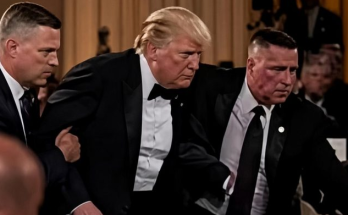
Inside the ballroom, pandemonium erupted. “Shots fired! Shots fired!” agents shouted. The Secret Service Counter-Assault Team, in full tactical gear, rushed the dais and formed a protective wall around the President and First Lady. Vice President Vance was swiftly evacuated through a side exit. Attendees dove under tables, crouching amid half-eaten burrata salads and linen cloths. Journalists, many veterans of war zones, instinctively reached for their phones—only to remember the notorious lack of cell service in the ballroom.
NBC’s Ali Vitali later described the surreal scene: “You’re under a table, you hear people shouting, and you can’t even text your family to say you’re okay.” In one corner, a brief, ill-advised chant of “USA! USA!” broke out before being silenced. The room fell into a heavy, terrified quiet as hundreds held their breath, fearing a second shooter or a breach of the ballroom doors.
The actual exchange of gunfire lasted less than thirty seconds, but the response stretched for hours. Security personnel from the Secret Service, Metropolitan Police, and TSA flooded the hotel. The perimeter was expanded by five blocks, and National Guard units positioned themselves outside. High-profile guests, including Rep. Steve Scalise, were escorted out under heavy guard. Allen was taken to a hospital for evaluation before facing federal charges, including assault on a federal officer and firearms violations.
By 11:00 p.m., President Trump returned to the White House still wearing his tuxedo. Standing with Kash Patel and Acting Attorney General Jeanine Pirro, he praised the Secret Service’s bravery before pivoting to a signature second-term priority: the proposed high-security presidential ballroom on White House grounds.
“Tonight proves it,” Trump said. “This is why I need my ballroom. Security is the reason, and tonight is the proof.”
The incident has ignited intense scrutiny. Questions remain about how Allen, a hotel guest, was able to get so close to the inner perimeter with weapons. Critics have highlighted the event’s reportedly lax ticketing system—essentially paper tickets once inside the hotel—as a major vulnerability.
The irony was lost on no one. Guests exited through the same doors where Hinckley once stood. Though no one was killed, the attack has forced a reckoning with security at large public political events. The “nerd prom,” meant to celebrate the press and the presidency, instead ended with journalists hiding under tables and fresh calls for fortified venues.
As investigations continue, Washington confronts a sobering reality: even the most high-profile gathering in the capital can turn into a battlefield in seconds. The conversation has shifted from celebration to survival, and the future of such events may never be the same.