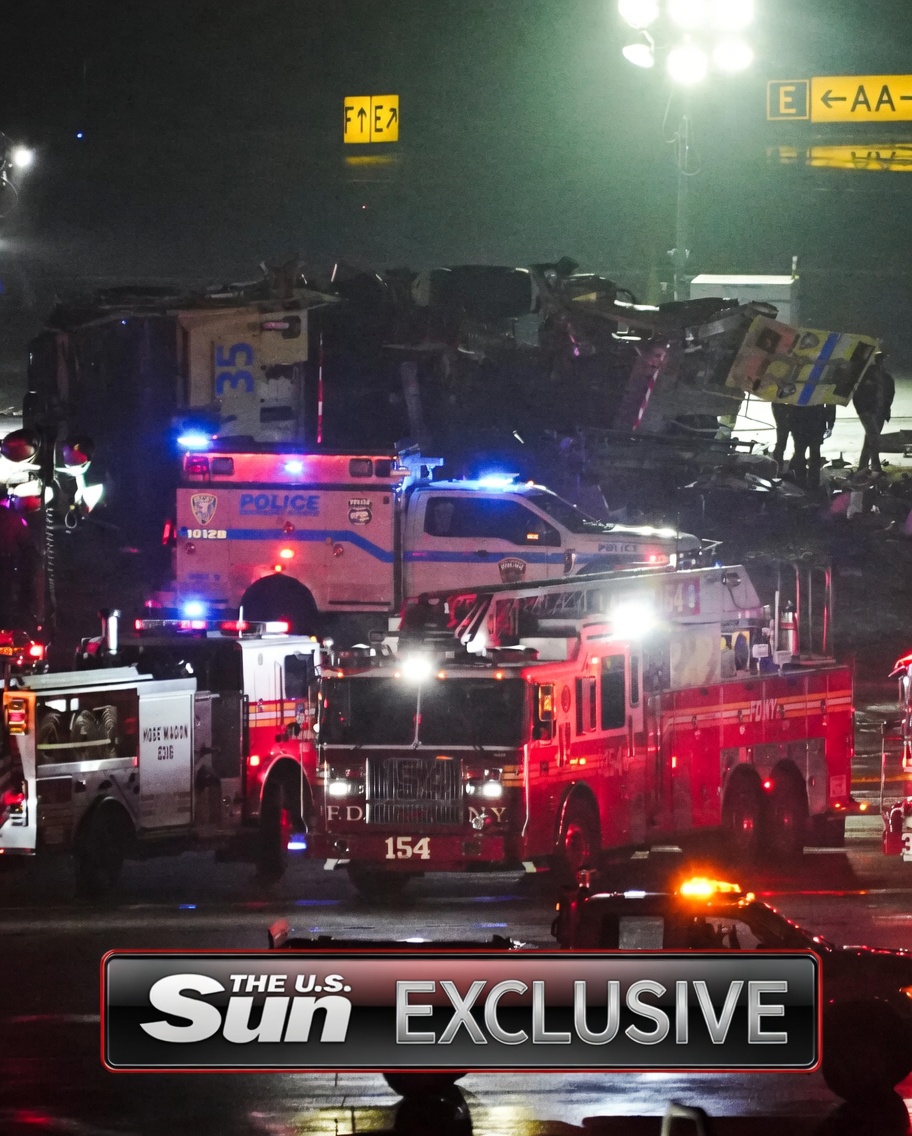
Aviation experts are raising urgent questions after a deadly runway collision at LaGuardia Airport left two pilots dead and dozens injured, with early scrutiny focusing on the decision to allow an emergency fire vehicle onto an active runway just as an incoming aircraft touched down. The collision happened Sunday night when an emergency response truck operated by the Port Authority of New York and New Jersey was dispatched to assist another aircraft, United Flight 2384, after crew members reported a strange odor inside the cabin and requested immediate support.
According to early accounts, the fire truck was attempting to reach the aircraft quickly and was authorized to cross the center section of the runway rather than take a longer route around the perimeter. At nearly the same moment, Air Canada Flight 8646 had already been cleared to land.
That decision proved catastrophic.
As the Air Canada aircraft descended and rolled onto the runway, it collided with the fire vehicle at high speed. The impact killed both pilots in the cockpit and sent shockwaves through the cabin, where passengers reported hearing a violent blast before the aircraft skidded across the runway.
Two pilots were later identified as Antoine Forest, from Coteau-du-Lac, Québec, and Mackenzie Gunther. Emergency crews arrived within moments, but the damage to the front of the aircraft was devastating.
Pilot and flight instructor David Evans said the tragedy may ultimately force airports to reconsider how emergency vehicles are allowed to move during active runway operations.
Evans argued that although the longer route would have delayed firefighters responding to the United aircraft, crossing at the far ends of a runway remains the safer option in most cases.
He explained that from a pilot’s perspective, vehicles should avoid entering the central runway whenever possible, even during emergencies. In his view, the added travel time is preferable to creating any possibility of conflict with landing aircraft.
He added that investigators will likely examine whether current airport procedures adequately address this kind of emergency and whether the rules should be tightened to prevent similar incidents.
“This is exactly the kind of event that aviation systems are designed to prevent,” Evans said, stressing that while emergencies require quick action, safety protocols must remain absolute.
A passenger who survived the crash described hearing a sudden “bang” immediately after landing, followed by confusion and fear inside the cabin as travelers struggled to understand what had happened.
Several passengers were treated for injuries, while others escaped physically unharmed but shaken. Witnesses said panic spread quickly as the aircraft slowed and cabin crew shouted instructions.
Evans also praised the actions of the flight crew in the final seconds before impact, saying the pilots likely did everything possible once they recognized the danger.
He noted that professional pilots are trained to react instinctively in emergencies and suggested the crew may have attempted evasive action, though they had little time at landing speed.
“Training becomes automatic,” he explained. “If there had been enough time to execute a go-around safely, they almost certainly would have tried.”
He called the survival of many passengers remarkable given the force of the collision, saying the outcome could have been far worse.
Visibility is also emerging as a possible factor in the accident. Aviation analysts believe darkness and runway lighting conditions may have limited the pilots’ ability to spot the truck before it was too late.
The investigation is now being led by the National Transportation Safety Board, which is examining why runway clearance was granted while the aircraft was still in its landing sequence.
Audio from the control tower captured the tense moments surrounding the crash.
In the recording, a controller is first heard instructing another aircraft to hold position.
Seconds later, the tone changes dramatically as the controller urgently shouts repeated warnings for the fire truck to stop.
“Stop, stop, stop, stop, truck one,” the controller yelled over the frequency.
Shortly afterward, another voice on the channel appears to acknowledge the error, saying an earlier emergency had complicated the situation and admitting, “I messed up.”
A second voice responded with reassurance, saying the controller had done the best possible under pressure.
The recording has intensified debate about whether fatigue, workload, or communication breakdowns played a role.
Still, Evans cautioned against rushing to blame controllers before the full sequence is understood. He said air traffic controllers routinely manage highly complex environments and generally perform at an exceptional level.
“They do a phenomenal job every day,” he said, while acknowledging that even small timing errors can have devastating consequences when aircraft and vehicles share the same movement area.
Sean Duffy also addressed speculation after the crash, rejecting reports that only one controller was staffing the tower at the time.
During a press briefing, Duffy and federal aviation officials urged Congress to approve sustained funding for modernization of air traffic systems nationwide, arguing that newer technology could help prevent future runway conflicts.
Evans, however, said money alone is not always the immediate answer.
Drawing on his own experience as a former elected official involved in airport oversight in California, he said calls for funding often follow major accidents, but investigators must first determine whether outdated equipment actually contributed.
He acknowledged that better systems can improve safety if they are properly used, but stressed that human procedures remain just as critical.
Investigators are now reconstructing the final seconds before impact. Early indications suggest the Air Canada jet had full landing clearance when the fire truck entered the same runway segment.
Controllers were also reportedly handling unusually heavy traffic after storms disrupted normal operations and forced schedule compression.
As the legal and technical investigation unfolds, Evans said one reality is unavoidable: major aviation accidents almost always lead to litigation, accountability battles, and difficult questions about who made the final call.
For families of the victims, however, the focus remains on two pilots who did not survive a collision many experts believe should never have happened. ✈️⚠️🚒