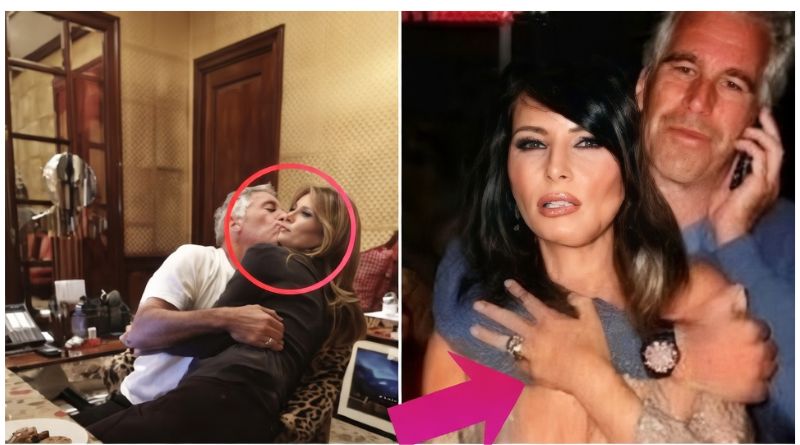
First Lady Melania Trump delivered a rare and pointed public statement from the White House on April 9, 2026, forcefully denying any personal or meaningful ties to the late convicted sex offender Jeffrey Epstein. In an unscheduled address that lasted roughly six minutes, she condemned what she described as persistent “lies” and “smears” linking her name to Epstein’s scandal, while calling on Congress to hold public hearings for his victims.
“The lies linking me with the disgraceful Jeffrey Epstein need to end today,” Trump began. She criticized those spreading the allegations as lacking “ethical standards, humility and respect,” adding that while she does not object to ignorance, she rejects “mean-spirited attempts to defame my reputation.”
Trump explicitly stated she has “never been friends with Epstein.” She acknowledged that she and her husband, President Donald Trump, were occasionally invited to the same social events as Epstein in New York City and Palm Beach, attributing this to the common overlap in elite social circles. However, she stressed there was no deeper connection.
“To be clear, I never had a relationship with Epstein or his accomplice, Maxwell,” she continued. She described her email reply to Ghislaine Maxwell as nothing more than “casual correspondence” and a “trivial note,” downplaying any significance.
The First Lady firmly rejected being portrayed as a victim. “I am not Epstein’s victim,” she said. She clarified that Epstein did not introduce her to Donald Trump; instead, the couple met by chance at a New York City party in 1998—an encounter she has detailed extensively in her memoir Melania. Their first crossing of paths with Epstein, she added, occurred in 2000 at an event they attended together, at which time she had no knowledge of his criminal activities.
Trump emphasized her complete lack of involvement in Epstein’s crimes. “I have never had any knowledge of Epstein’s abuse of his victims. I was never involved in any capacity. I was not a participant, was never on Epstein’s plane and never visited his private island.” She noted that her name has never appeared in court documents, depositions, victim statements, or FBI interviews related to the case, and she has never been accused or convicted of any related wrongdoing.
She also warned about the proliferation of fake images and fabricated stories circulating on social media for years, urging the public to approach them with caution. “These images and stories are completely false,” she said. “I’m not a witness or a named witness in connection with any of Epstein’s crimes.”
Trump revealed that she and her attorneys have actively fought these claims, achieving legal successes including public apologies and retractions from outlets and individuals such as the Daily Beast, political commentator James Carville, and publisher HarperCollins. “My attorneys and I have fought these unfounded and baseless lies with success and will continue to maintain my sound reputation without hesitation,” she declared.
The statement took a broader turn toward accountability. “Now is the time for Congress to act,” Trump said. “Epstein was not alone. Several prominent male executives resigned from their powerful positions after this matter became widely politicized.” While noting that resignations do not equate to guilt, she advocated for transparency.
In a notable pivot, she called for Congress to organize public hearings centered on Epstein’s survivors. “Give these victims their opportunity to testify under oath in front of Congress with the power of sworn testimony. Each and every woman should have her day to tell her story in public if she wishes, and then her testimony should be permanently entered into the congressional record. Then, and only then, we will have the truth.”
The address, delivered in the White House’s Grand Foyer without taking questions, surprised many observers. It came at a time when the Trump administration had appeared eager to move past the Epstein saga, which has lingered as a political distraction during the president’s second term. Some insiders suggested the First Lady’s decision stemmed from months of frustration with ongoing media coverage and online speculation. President Trump later told reporters he knew his wife intended to address the topic at some point but was not aware of the exact content, adding that he believed she “had a right to talk about it.”
Reactions have been mixed. Some Epstein survivors welcomed the call for congressional hearings as a step toward justice and visibility. Others expressed skepticism, viewing the statement as potentially self-serving or an attempt to preempt further scrutiny. Democrats, including Rep. Robert Garcia of the House Oversight Committee, expressed agreement with the push for public victim testimony. Meanwhile, the surprise nature of the remarks sparked speculation in Washington about whether new developments might be on the horizon.
Throughout her remarks, Melania Trump positioned herself as a defender of her own reputation while shifting focus toward support for victims and greater transparency. The episode has thrust the Epstein files back into the national conversation, raising questions about the full scope of accountability for those connected to the disgraced financier and his network.
As the political world digests the statement, it remains to be seen whether Congress will heed the First Lady’s call for sworn public hearings. For now, Melania Trump’s direct intervention has ensured that the demand for truth—and closure—continues to echo.