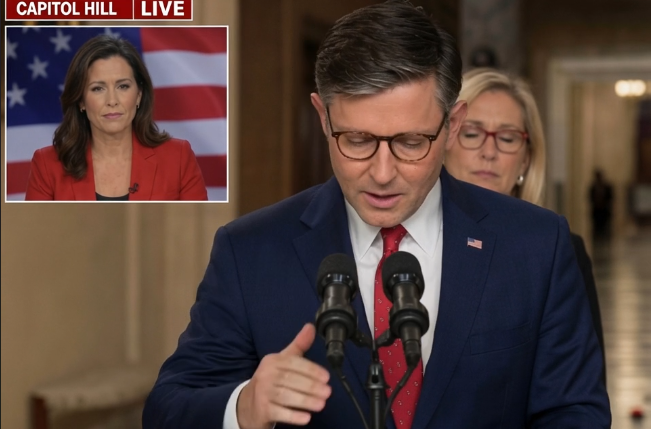
House Speaker Mike Johnson (R-La.) has announced a procedural plan aimed at advancing the SAVE America Act by linking it to the National Defense Authorization Act (NDAA), one of Congress’s most significant annual pieces of legislation. The move reflects House Republican efforts to increase pressure on the Senate to consider the election-related measure.
The proposal follows weeks of internal Republican negotiations after a group of conservative lawmakers temporarily delayed House business while urging leadership to take stronger action on the SAVE America Act. The House approved the legislation earlier this year. The bill would require individuals registering to vote in federal elections to provide proof of U.S. citizenship and establish photo identification requirements for casting ballots.
Speaking with reporters, Johnson said House Republicans intend to use a parliamentary procedure known as “merge onto the rule,” sometimes referred to as “MIRVing,” to attach the SAVE America Act to the rule governing debate on the NDAA. Under the strategy, members voting in favor of advancing the defense bill would also support moving the election measure forward.
Johnson said the approach demonstrates the House majority’s commitment to election security while encouraging the Senate to consider the legislation alongside the annual defense authorization bill. He argued that the procedural vote would reinforce Republican priorities on both national defense and election integrity.
Despite the proposal, significant legislative hurdles remain. Even if the combined package passes the House, the Senate could remove the election provisions during its consideration of the NDAA. Some lawmakers have also expressed concern that attaching additional legislation could complicate or delay passage of the annual defense bill.
The strategy has generated differing views within the Republican conference. Some members support Johnson’s approach as a practical way to advance the legislation, while others favor incorporating the election provisions directly into the NDAA through amendments. Democrats continue to oppose the SAVE America Act, arguing its requirements could create barriers for eligible voters, while Republicans maintain the legislation is intended to strengthen confidence in federal elections by verifying voter eligibility.
As Congress continues negotiations, the future of both the NDAA and the SAVE America Act remains uncertain, underscoring ongoing debates over election policy, legislative procedure, and bipartisan cooperation.