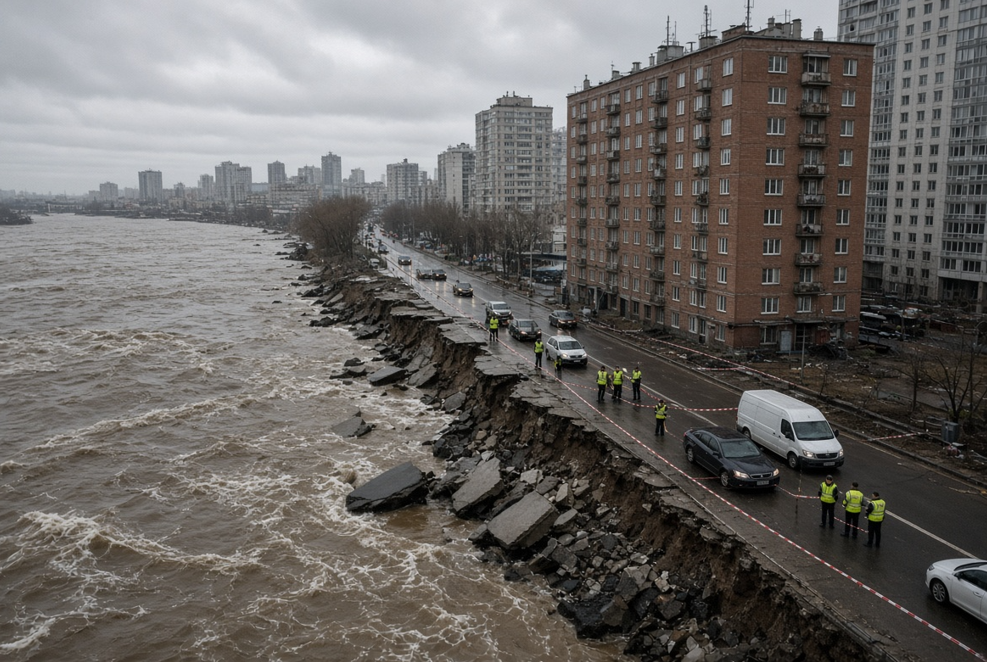
A high, fixed camera looks down on a narrow coastal street and a swollen river. On the left, a wide channel of muddy brown water moves hard and fast, tearing at what is left of the bank. Chunks of the concrete walkway have already broken away and sit half-submerged in the current. A two-lane road runs beside the water. Traffic has stopped. A white van and a dark car sit among other vehicles that will not move any closer.
Emergency crews in bright yellow vests work the damaged edge of the pavement. They have stretched red-and-white tape across the approach so that no one drives or walks into the gap. On the inland side of the road, a row of high-rise apartment blocks rises over the street. One of them, a large brick-faced building, is no longer true. It begins to lean toward the river.
The lean is slow at first, then unmistakable. The structure tips farther as its foundations give way. Neighboring towers stay upright. The falling block does not. In a few seconds it goes over completely and slams into the river. The impact throws a wall of water and debris into the air. A thick gray cloud of dust and pulverized concrete bursts outward and rolls across the road, swallowing the tape, the vans, and the lower faces of the buildings that are still standing.
The river churns harder around the wreckage as the mass settles into the bed. Water from the splash reaches the lower floors of the adjacent blocks. The road itself looks worse than it did before the fall, ripped farther from its original line. The people on the ground do not run in the frame. They stand still, small against the scale of the building.
The skyline beyond is gray and overcast. Nothing in the light softens the scene. The contrast is simple: one tower moving, the others still. The vehicles look tiny. The dust keeps spreading after the crash, hiding the street for several beats.
The setup was already a warning. The broken walkway, the parked emergency vehicles, and the tape all say the bank had failed before the building did. What the recording captures is the last step: a high-rise leaving its footprint and going into the water. Whether the cause is riverbank erosion, a failed foundation, or both, the pictures show the same thing—an urban structure that could not hold once the ground under it was gone.
The clip is brief and clear. It has the look of a document of sudden structural failure next to moving water. It also belongs to a class of videos that travel fast online, often with claims that they show a named flood or a named city. Similar sequences have been shown to be generated rather than filmed. The images remain stark either way: a river eating a bank, a road held by tape, and a building that does not stay up.