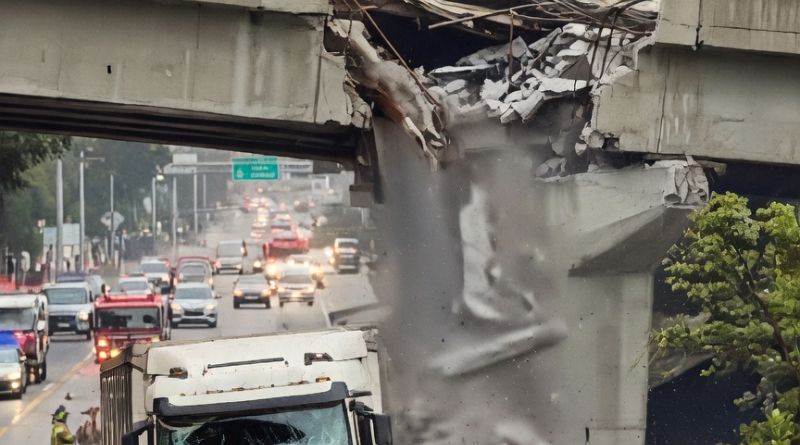
On a quiet Friday morning in February 2023, commuters in Richmond, British Columbia, encountered a major disruption when a commercial truck towing a dump trailer collided with the Cambie Road overpass on Knight Street. The incident occurred around 7:15 a.m. Pacific Time, forcing the immediate closure of all southbound lanes and prompting a thorough structural inspection of the overpass and adjacent bridge deck.
Investigators determined that the truck was traveling southbound with the dump trailer raised in a vertical position. The elevated bed failed to clear the overhead structure, striking the overpass with significant force. The impact lodged the trailer against the concrete span and detached the truck cab, which came to rest a short distance away. Video footage shared on social media captured the trailer bed remaining raised for at least 20 seconds before the collision, highlighting a clear lapse in preparation.
Fortunately, no injuries were reported. However, the force of the impact raised immediate concerns about the bridge’s structural integrity. City and provincial officials responded swiftly, with engineers arriving on site to assess potential damage before any decision could be made about reopening the roadway.
Immediate Response and Safety Assessments
Although the section of highway falls under provincial jurisdiction, the City of Richmond deployed municipal engineers to assist the Ministry of Transportation and Infrastructure. Their joint priority was to evaluate whether the overpass and Knight Street Bridge could safely accommodate normal traffic loads following the collision.
By late morning, the raised trailer bed remained pressed firmly against the concrete structure while crews worked to clear debris and stabilize the scene. Police directed motorists to alternative routes, warning of heavy congestion as rush-hour traffic backed up across the area. The Richmond Road Safety Unit (RSU) assumed lead responsibility for the investigation, collaborating closely with provincial authorities on a detailed structural and engineering review.
This assessment involved checking for cracks, joint displacement, weakened support beams, or any other signs of compromise caused by the impact. Non-destructive testing methods and visual inspections were employed to ensure no hidden damage threatened long-term stability.
A Recurring Challenge in British Columbia
This Knight Street incident was far from isolated. Over-height collisions with overpasses have become a persistent problem across British Columbia’s Lower Mainland and Fraser Valley. Provincial records document multiple strikes each year, often involving commercial vehicles with raised dump beds, improperly secured loads, or loads exceeding measured heights.
In recent years, similar crashes have occurred in locations such as Langley, Delta, Abbotsford, and other points along major routes like Highway 1 and Highway 99. One analysis noted that these incidents frequently stem from common factors: failure to lower hydraulic or dump mechanisms, inadequate pre-trip height verification, or driver unawareness of clearance restrictions. While driver error plays a central role, experts also point to contributing infrastructure issues, including aging bridges, inconsistent or missing clearance signage, and occasional reductions in vertical clearance due to road resurfacing projects.
The province maintains a public database of bridge and overpass strikes, which helps track patterns and assign accountability to carriers. In some cases, entire fleets have faced suspensions pending investigations into permitting and load-height compliance.
Industry Reactions and Calls for Reform
The British Columbia Trucking Association (BCTA) has advocated for a multifaceted approach to prevention. The organization recommends wider deployment of over-height detection systems—technologies that use laser or infrared sensors to identify tall loads and trigger warning signs or alerts well before a low-clearance structure is reached.
Fleet operators are also encouraged to strengthen internal protocols. This includes rigorous driver training on verifying trailer positions, conducting thorough pre-trip inspections, and cross-checking route clearances against vehicle and load dimensions. Proper securing of hydraulic mechanisms is especially critical for dump trucks and similar equipment.
Transportation professionals emphasize data-driven strategies. By analyzing incident trends, authorities can pinpoint high-risk corridors, prioritize infrastructure upgrades, and inform investment decisions. Recurring problem spots can receive enhanced signage, sensor installations, or even geometric modifications to improve clearances.
Engineering Perspective: Hidden Risks and Thorough Evaluation
From a structural engineering standpoint, even seemingly minor impacts warrant serious attention. A collision of this nature can introduce stresses to internal reinforcements, loosen critical joints, or create micro-damage that may not be visible on the surface. Engineers stress that every overpass strike must trigger comprehensive inspections, sometimes including load simulations and advanced non-destructive testing, before traffic resumes.
In the Knight Street case, officials conducted evaluations of the bridge deck, Cambie Road overpass, and surrounding areas. Thorough assessment protects public safety and prevents far more expensive failures down the line. Repair costs for significant overpass damage in British Columbia have occasionally climbed into the millions, often covered through a combination of insurance claims and public budgets.
Broader Traffic and Economic Impacts
Knight Street serves as a vital artery connecting Richmond with Vancouver, Delta, and the Fraser Valley. As a key corridor for commercial trucking and daily commuting, its closure creates widespread ripple effects. Southbound traffic was diverted to secondary roads such as No. 5 Road and Shell Road, adding significant time to commutes and increasing fuel consumption.
Businesses reliant on timely deliveries experienced short-term disruptions, while logistics operators faced delays that cascaded through supply chains. These incidents highlight the hidden economic toll of infrastructure collisions: not only direct repair expenses but also lost productivity, congestion-related costs, and strain on regional transportation networks.
Preventive Strategies: Technology, Training, and Policy
Safety advocates promote an integrated “safety ecosystem” to reduce future occurrences. Key recommendations include:
- Over-height detection systems: Laser or sensor-based alerts that warn drivers in real time.
- Real-time fleet monitoring: GPS-integrated tools that notify operators when vehicles approach restricted routes.
- Enhanced driver training: Ongoing programs that reinforce height awareness, especially for vehicles with variable configurations like dump trailers.
- Regular infrastructure audits: Periodic verification of clearance heights and signage accuracy, accounting for any changes from maintenance work.
Experts note that no single measure will eliminate the risk entirely. Prevention requires shared accountability among drivers, fleet managers, trucking companies, and government agencies. Integrating clearance data directly into commercial GPS navigation systems—already common in some jurisdictions—could further reduce reliance on manual checks and physical signs.
Transportation policy discussions in Canada increasingly focus on modernizing aging infrastructure amid growing freight volumes and larger vehicle sizes. Proposals under consideration include mandatory detection technology on critical corridors and stronger enforcement of load permitting rules.
Lessons from the Richmond Incident
The Knight Street collision demonstrates how a momentary oversight—leaving a trailer bed raised—can snarl traffic across an entire region and trigger resource-intensive investigations. While the event resolved without injuries or catastrophic structural failure, it carried notable financial and operational costs.
For government agencies, the takeaway is clear: proactive investment in detection technology, signage improvements, and maintenance is far more economical than reactive repairs. For the trucking industry, the incident reinforces the need for disciplined pre-trip protocols, continuous training, and adoption of available safety tools.
Public communication also matters. Timely updates on closures, detours, and reopening timelines help commuters and businesses plan effectively and maintain trust in the transportation system.
Conclusion
Although no one was physically harmed in the Richmond overpass strike, the event belongs to a broader pattern that cannot be ignored. Heavy commercial vehicles are indispensable to Canada’s economy, yet their safe interaction with the province’s infrastructure demands ongoing vigilance.
By treating road safety as a collective responsibility—merging advanced technology, rigorous training, consistent enforcement, and strategic infrastructure investment—British Columbia can reduce the frequency of these disruptive incidents. The Knight Street experience serves as a valuable reminder: preventing collisions protects not only lives and property but also the smooth flow of goods and people that underpins regional prosperity.


