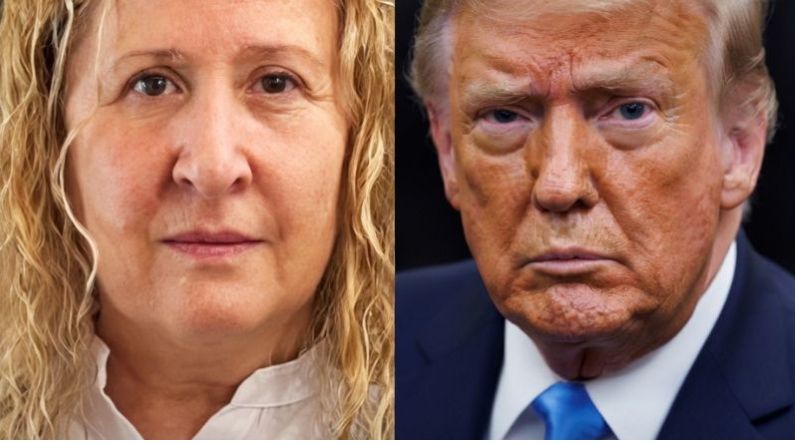
A surprising paternity claim involving U.S. President Donald Trump has sparked widespread online debate and media attention in recent months. At the center is Necla Özmen, a 55-year-old woman from Ankara, Turkey, who publicly asserts that she is Trump’s biological daughter and has repeatedly called for a DNA test to confirm or disprove her allegation.
Özmen filed a paternity lawsuit in September 2025 at Ankara’s 27th Family Court, requesting court-ordered genetic testing. According to her account, she was born in 1970 and officially registered as the daughter of Satı and Dursun Özmen, the couple who raised her. She claims that in 2017, her adoptive mother revealed a different story: Satı had given birth to a stillborn child at a Turkish hospital, after which another woman — identified by Özmen as a U.S. citizen named Sophia — handed over a newborn baby in what she describes as an informal swap. Özmen alleges that Sophia became pregnant through an extramarital relationship with Trump and later relinquished the child. She has pointed to supposed physical resemblances between herself and Trump (and some of his known children) and has even displayed AI-generated images of the two together during public statements.
Turkish courts dismissed the case, ruling that Özmen failed to provide sufficient concrete evidence to justify proceeding. Her appeal in Turkey was also rejected on similar grounds. Undeterred, Özmen has escalated her efforts internationally. She has sent petitions to the U.S. Embassy and pursued legal avenues in American courts, with reports indicating that her application was accepted for further procedural review as of early 2026. She has also used public appearances to urge Trump to agree to DNA testing, stating simply, “I just want to know the truth.”
As of April 2026, the claim remains entirely unverified. No DNA test has been conducted, and neither President Trump nor his representatives have issued any public response or comment on the matter. DNA paternity testing is widely regarded as the most reliable scientific method for establishing biological relationships, with accuracy rates exceeding 99.99% when performed correctly. However, such tests require voluntary participation from the alleged parent or a enforceable court order with proper jurisdiction — neither of which is currently in place.
Legal experts note that high-profile cases like this often involve significant hurdles related to jurisdiction, privacy rights, and the need for credible preliminary evidence before courts can compel testing. Without mutual cooperation or compelling documentation linking Trump to the events described in 1970 (when he was in his early 20s and focused on his early real estate career in New York), the allegation faces an uphill battle.
Public reaction has been mixed. Some observers express curiosity or amusement, sharing memes and speculation online, while most remain highly skeptical due to the complete lack of corroborating evidence. The story has been covered by Turkish outlets such as Daily Sabah and international media, often framed as unusual or unsubstantiated.
In the end, this remains a personal allegation rather than a proven fact. Extraordinary claims require extraordinary evidence, and at present, none has emerged beyond Özmen’s persistent statements and legal filings. Until credible verification or testing occurs — if it ever does — the situation stays firmly in the realm of speculation. Verification, not rumor, will ultimately determine any resolution.