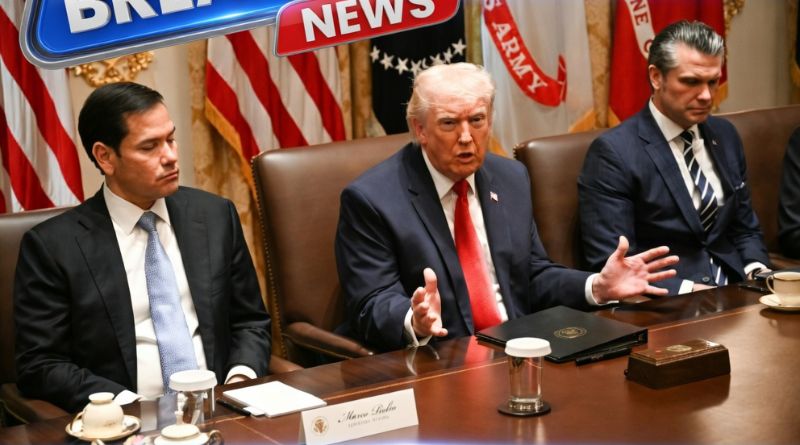
President Donald Trump declared on Friday that U.S. and allied forces have entered the final phase of their joint military campaign against Iran, known as Operation Epic Fury. Speaking at a keynote address during the Future Investment Initiative Priority Summit in Miami, Trump reported that thousands of targets had already been struck, with approximately 3,554 remaining.
“We have another 3,554 targets left, and that will be done pretty quickly,” Trump said. “And then at some point, we’re going to have to determine what we do.”
The operation, launched on February 28 in coordination with Israel, has focused on degrading Iran’s ballistic missile systems, naval capabilities, defense industrial base, and support for regional proxy groups. It also aims to prevent Tehran from developing a nuclear weapon. According to U.S. Central Command, more than 10,000 targets have been hit since the campaign began, with officials claiming significant degradation of Iran’s conventional military power.
Initially planned as a four- to six-week effort, the campaign has delivered what the administration describes as overwhelming results in just over a month. Trump projected confidence that core objectives are nearing completion, telling the audience, “We’re closer than ever to the rise of the Middle East that is finally free at last from Iranian terror, aggression, and nuclear blackmail.”
Trump also asserted that Iran is actively seeking negotiations despite public denials from Tehran. “They are negotiating. They’re begging to make a deal,” he said. Central to any potential agreement is the Strait of Hormuz, the vital chokepoint through which a large portion of the world’s oil supply passes. Disruptions to shipping in the strait have already caused volatility in global energy markets.
“They have to open it up, the Strait of… Hormuz,” Trump said, momentarily stumbling over the name before correcting himself, drawing laughter from the crowd. He stressed that unrestricted international access to the waterway remains a non-negotiable condition for any diplomatic resolution.
For nearly five decades, Trump argued, Iran has acted as the dominant destabilizing force in the region. “For 47 years, Iran has been known as the bully of the Middle East,” he said. “But they are not the bully any longer. They’re on the run.”
The administration has not released detailed information on the specific nature of the remaining targets or an exact timeline for completion. However, Trump’s remarks indicate that military planners view the operation as entering its concluding stage. He stopped short of declaring an end to hostilities, noting that broader strategic decisions about the region’s future would follow once major combat actions wind down.
The joint U.S.-Israeli effort has drawn intense international attention due to its implications for Middle East stability, global energy security, and geopolitical alignments. While the campaign has achieved notable military successes, analysts caution that the final phase carries risks, including potential asymmetric responses from Iran or escalation through its remaining proxy networks.
Even as strikes continue on remaining targets, questions persist about the post-operation landscape. These include the long-term management of the Strait of Hormuz, the future of Iran’s nuclear program, and the broader effort to reshape regional dynamics away from Iranian influence.
Trump framed the campaign as a decisive demonstration of “peace through strength,” arguing that sustained pressure has forced Iran into a weakened position and opened the door for potential negotiations. As the operation approaches what many hope will be its conclusion, the focus is shifting toward whether military gains can translate into a lasting diplomatic arrangement that secures U.S. and allied interests in one of the world’s most volatile regions.