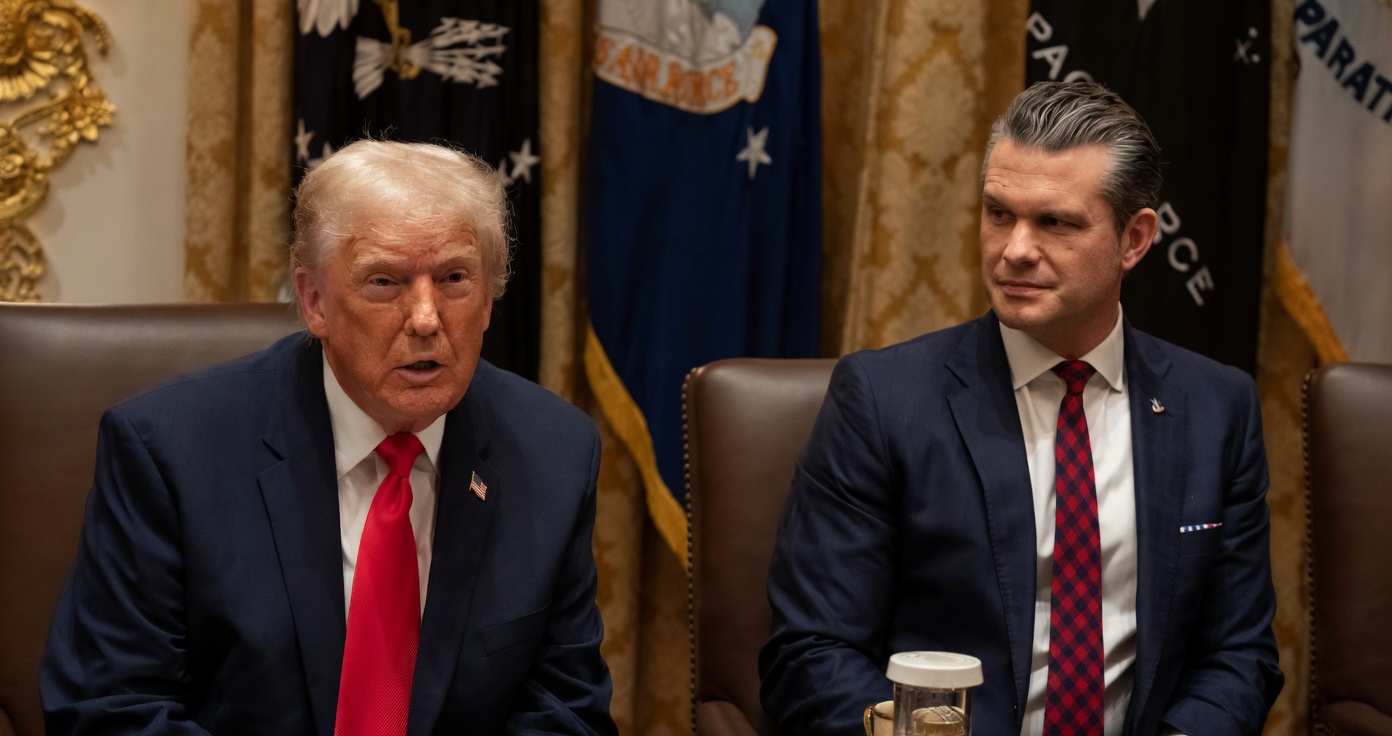
President Trump voiced full confidence in Defense Secretary Pete Hegseth amid two controversies: the so-called “Signalgate” affair and allegations surrounding a strike on a suspected Venezuelan drug-trafficking boat.
Speaking aboard Air Force One on Sunday, Trump addressed claims that Hegseth ordered military forces to “leave no survivors” in a September 2025 Caribbean operation targeting a vessel believed to be involved in drug trafficking linked to Venezuela. “He said he did not say that, and I believe him 100%,” Trump told reporters, while downplaying Democratic calls for Hegseth’s resignation. Hegseth has denied the allegation, describing it as “fake news” and citing the “fog of war.” The incident involved an initial strike followed by a second one that reportedly killed survivors clinging to wreckage, prompting criticism and demands for investigation from some lawmakers.
Separately, a Pentagon inspector general report on Signalgate—expected to be released publicly around early December 2025—has become a flashpoint. The controversy erupted in March 2025 when National Security Adviser Mike Waltz accidentally added Jeffrey Goldberg, editor-in-chief of The Atlantic, to a Signal group chat. The chat included Hegseth, Vice President JD Vance, and other senior officials discussing planned U.S. strikes against Iran-backed Houthi targets in Yemen as part of Operation Rough Rider. Messages attributed to Hegseth reportedly shared operational details, including strike timing and aircraft involvement, roughly two hours before execution. The operation ultimately involved over 800–1,000 strikes on Houthi targets.
Navy Reserve Commander Tim Parlatore, an attorney and senior adviser to Hegseth, told Just the News that the report “totally exonerates” the secretary. Parlatore emphasized that no classified information was shared and that Hegseth acted within his authority to declassify material. He highlighted a “tiny little section” expressing an opinion that the use of an unclassified channel could have endangered troops, but noted it was “untethered” from the rest of the report and unsupported by specific evidence from the investigation.
Parlatore added that the report reveals broader issues, including widespread reliance on the Signal app among national security officials dating back to 2020, and improper personal cellphone practices by former Defense Secretary Lloyd Austin, such as bringing devices into secure facilities (SCIFs). According to Parlatore, Hegseth rejected following Austin’s approach and instead directed his team to find a legal and secure method for communications. “I don’t want to break the law. Give me something that’s legal and secure,” Parlatore quoted Hegseth as saying.
The inspector general’s findings, however, concluded that Hegseth sent sensitive, nonpublic operational information via his personal cellphone on the commercial Signal app, violating Department of Defense policies on device use, approved communications systems, and record-keeping. The report noted this created risks to operational security that could have harmed U.S. pilots or mission objectives had the details been intercepted—though no actual compromise occurred. Hegseth’s defenders maintain he complied with classification rules under his original classification authority.
The incidents underscore ongoing debates over secure communications, aggressive counter-trafficking and counter-Houthi operations, and partisan divides in Washington. Trump continues to back Hegseth strongly as the administration pursues hardline policies against drug networks and regional threats.