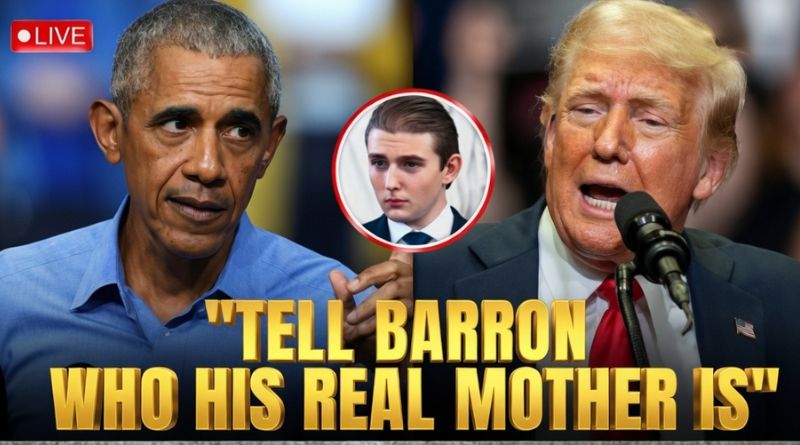
At a campaign rally in Atlanta, former President Donald Trump shifted from familiar attacks on policy and opponents to a personal jab at Michelle Obama. “She was nasty to me,” Trump said, drawing cheers from the crowd. He responded to her recent campaign criticism of him as erratic and in mental decline, suggesting she had opened the door by going after him first. The remark fit Trump’s signature style: blunt, theatrical, and aimed at energizing supporters who see such exchanges as unfiltered authenticity.
Clips spread rapidly on social media, sparking criticism from Democrats and some independent voices who called the attack gratuitous. They argued it targeted a private citizen who holds no current office and could not respond in the moment. Others viewed it as part of a long-running pattern in which personal insults often overshadow substantive debate.
The following week, Barack Obama addressed the exchange. In a measured video posted to his social media accounts, the former president spoke calmly from behind a desk, sleeves rolled up. He avoided immediate name-calling and instead set a broader frame: “There are lines you don’t cross—not because the other side deserves protection, but because the country does.”
Obama acknowledged that politics has always involved sharp criticism and even cruelty. Yet he argued that dragging family members into the fray reveals weakness rather than strength. “If you can’t defend your ideas,” he said, “you attack someone’s dignity.” He then listed Michelle Obama’s initiatives as first lady—improving school nutrition, supporting military families through Joining Forces, and advocating for girls’ education worldwide—offering a factual contrast to the rally rhetoric.
His most quoted line captured the moment: “The easiest thing in politics is to be cruel. The hardest thing is to be useful.” Supporters praised the response as composed and principled, positioning it as a defense of civic standards over partisan combat.
Only later did Obama address Trump directly. “Donald,” he said evenly, “you’ve spent your life confusing dominance for strength.” He challenged him to name one policy defended that week without insulting a woman, framing the test as a matter of basic conduct. Obama closed by noting that Michelle needed no defense from him—she had already proven her record—but that he spoke for the sake of younger Americans watching: bullying is not leadership.
Reactions split along predictable lines. Trump’s backers dismissed Obama’s video as staged and weak, while many on the left hailed it as a model of restraint. Some conservative commentators agreed the original remarks about Michelle Obama were unnecessary, even if they defended Trump’s overall combative approach.
The episode distilled deeper tensions in American politics. For Trump, sharp personal attacks remain a tool of disruption and connection with voters tired of scripted decorum. For Obama, the emphasis stays on norms, usefulness, and the long-term example set for the country. Both approaches have proven effective with their bases—Trump’s in building loyalty through defiance, Obama’s in appealing to aspirations of civility and competence.
In a polarized nation, such exchanges rarely convert undecided voters. They instead reinforce competing visions of strength: one rooted in volume and willingness to hit back, the other in disciplined restraint and focus on results. The brief confrontation ultimately became less about a single remark and more about which definition of leadership resonates amid enduring cultural and political divides.