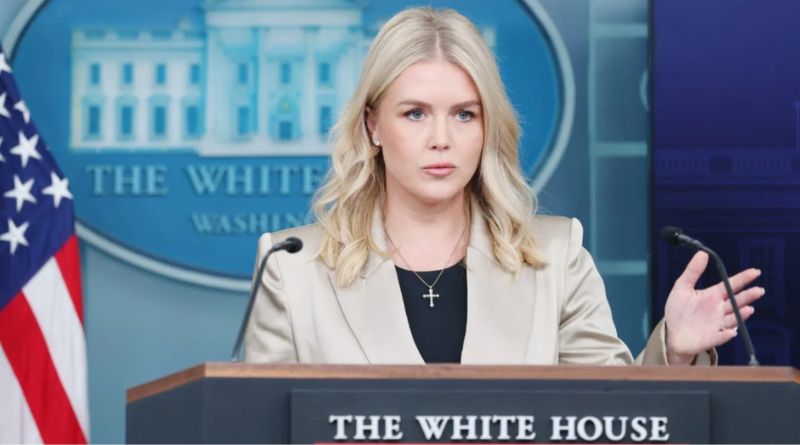
White House Press Secretary Karoline Leavitt engaged in a sharp exchange with CNN anchor Kaitlan Collins during a recent press briefing over President Donald Trump’s efforts to deploy the National Guard to Portland, Oregon.
Collins pressed Leavitt on whether the deployment was truly necessary, pointing to statements from Portland’s police chief that the president’s description of the situation did not align with conditions on the ground. Leavitt pushed back forcefully, accusing Collins of relying on partisan sources and failing to examine the unrest firsthand.
“I would encourage you, as a reporter, to go on the ground and take a look for yourself,” Leavitt said. She highlighted accounts from independent journalists who had witnessed the chaos directly, noting that video evidence showed “anarchy” occurring “night after night.”
When Collins tried to interrupt, Leavitt continued: “You’re probably talking to partisan Democrat officials who are opposed to everything this president does.” She urged reporters to speak with Portland residents directly affected by the disturbances, emphasizing that the individuals involved were not engaged in peaceful protest but were instead intent on causing “mayhem and havoc.”
The tense exchange reflects broader friction between the Trump administration and segments of the media regarding coverage of protests and federal responses. Trump has argued that local leaders in Portland have failed to maintain order, particularly around the city’s Immigration and Customs Enforcement (ICE) facility, where clashes between demonstrators and federal agents have persisted for months. The administration framed the National Guard deployment as essential to protect federal property, ICE officers, and local residents amid repeated violence.
Protests outside the Portland ICE building intensified in mid-2025, driven largely by opposition to the administration’s immigration enforcement policies. While many demonstrations included peaceful elements, authorities and independent observers documented incidents involving gate-breaching attempts, assaults on officers, property damage, and the use of crowd-control munitions by federal agents. Local officials, including Democratic leaders, often described the situation as manageable by existing law enforcement and criticized federal intervention as unnecessary overreach.
In late September 2025, Trump directed the federalization of National Guard troops—including units from Oregon and other states like California—to support operations in Portland. The move invoked federal statutes allowing the president to call up the Guard in cases of rebellion or when regular forces cannot execute federal laws.
However, U.S. District Judge Karin Immergut, a Trump appointee, repeatedly blocked the plan. In a permanent injunction issued in November 2025, she ruled that the deployment lacked a lawful basis under 10 U.S.C. § 12406 and violated the Tenth Amendment by infringing on state sovereignty. Immergut determined that the protests, while involving some violence, did not constitute a “rebellion” severe enough to justify military intervention and that local and federal law enforcement could handle the situation.
Critics of the ruling argued it downplayed the cumulative impact of ongoing clashes and ignored Portland’s history of unrest, including limited local cooperation with federal immigration operations. The administration appealed the decision, but by early 2026, Trump announced he was pausing the Portland National Guard effort “for now,” with mobilized troops eventually demobilized.
The episode underscores deep divisions over federal versus local authority, the limits of presidential power in domestic law enforcement, and how media portrayals shape public understanding of urban protests. As demonstrations continue intermittently, the underlying tensions over immigration enforcement and public order in Portland remain unresolved.