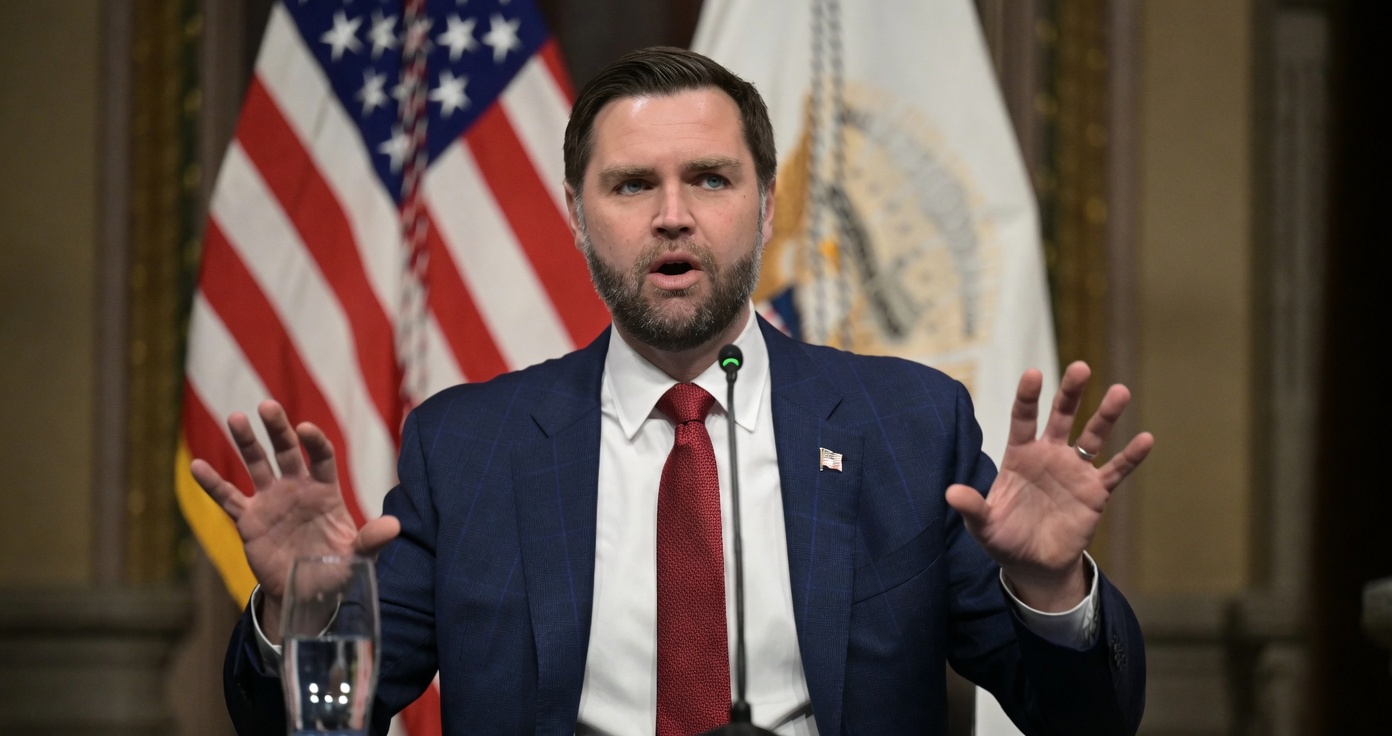
Vice President JD Vance convened the first meeting of the White House Task Force to Eliminate Fraud on Friday, March 27, 2026, at the Eisenhower Executive Office Building, warning that large-scale fraud in federal benefit programs is far more widespread than previously recognized.
Speaking in the Indian Treaty Room, Vance highlighted a major fraud scandal in Minnesota as a stark example of a problem repeating across states and programs. “What we’re seeing in Minneapolis is replayed again and again across many different states and across many different programs,” he said. “It has to stop. The president of the United States has ordered us to stop it, and that’s what this task force is going to do.”
President Trump announced the task force during his February State of the Union address and formally established it by executive order on March 16. The initiative forms a core part of the administration’s push for greater accountability in federal spending, especially as the 2026 midterm elections approach.
The task force adopts a “whole-of-government” strategy, uniting senior officials from multiple agencies to detect, prevent, and prosecute fraud in programs providing food assistance, housing support, medical care, and other public benefits. Vance stressed that the issue goes beyond wasted taxpayer dollars. “This is not just the theft of the American people’s money,” he said. “It is also the theft of critical services that the American people rely on.”
Key members include Federal Trade Commission Chair Andrew Ferguson as vice chair and senior White House adviser Stephen Miller as a senior adviser. The group also incorporates Justice Department officials from a newly created division dedicated to fraud prosecutions. Each federal agency will audit its own programs, implement stronger safeguards such as enhanced identity verification and pre-payment controls, and pursue targeted investigations.
Vance pointed to revelations in Minnesota, where federal prosecutors have estimated that as much as $9 billion in federal funds may have been improperly obtained from state-administered social service programs since 2018. More than 100 individuals face charges in related schemes, with dozens already convicted. These cases often involve billing for undelivered services in areas like autism therapy, housing stabilization, and pandemic-era relief.
Ferguson described the fraud as an existential threat. “This fraud crisis is thus existential,” he said. “If we fail to address it, the fabric of our nation will swiftly unravel.”
The effort intersects with ongoing debates over immigration enforcement and oversight of state-run programs. Administration officials argue that existing safeguards have not kept pace with sophisticated fraud operations, sometimes involving nonprofits and ineligible recipients.
Vance’s prominent role in leading the task force elevates his profile in the administration’s domestic agenda. He framed the initiative as urgent work to protect both taxpayers and legitimate program beneficiaries. “It’s happening across the country,” Vance said, “and we’re going to stop it.”
The task force plans regular meetings and has set aggressive timelines for agencies to strengthen controls and improve coordination with the Justice Department.