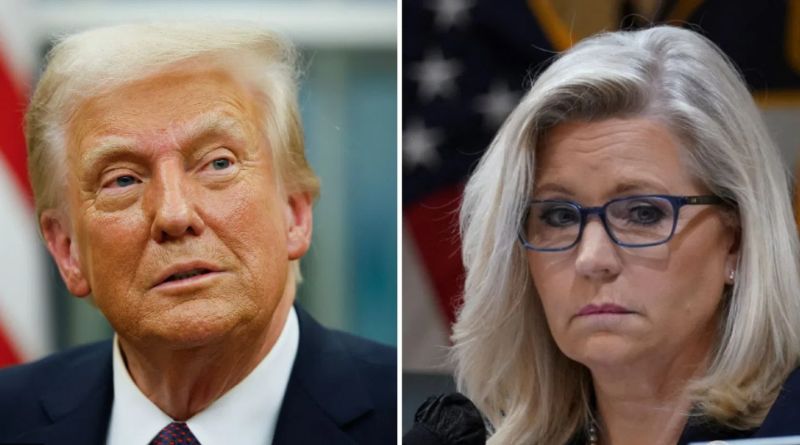
President Donald Trump sharply criticized former Republican Rep. Liz Cheney on Monday, January 20, 2025, shortly after taking office, following a series of last-minute preemptive pardons issued by outgoing President Joe Biden.
While signing executive orders in the Oval Office on his first day back in the White House, Trump addressed reporters and touched on several topics, including his broad clemency for individuals involved in the January 6, 2021, Capitol events. Trump granted full pardons to roughly 1,500 people charged or convicted in connection with the riot and commuted sentences for 14 others, referring to many of them as “J6 hostages.”
“I was going to talk about the J6 hostages, but you’ll be happy because, you know, it’s action, not words that count, and you’re going to see a lot of action on the J6 hostages,” Trump said. He then pivoted to Biden’s pardons, which shielded several high-profile figures from potential future prosecutions.
Hours before leaving office, Biden issued preemptive pardons for former NIAID Director Dr. Anthony Fauci, retired Gen. Mark Milley (former Chairman of the Joint Chiefs of Staff), members and staff of the House Select Committee investigating the January 6 attack—including former Rep. Liz Cheney—and some Capitol and D.C. police officers who testified before the panel. Biden also extended pardons to several members of his own family.
Trump questioned the motivation behind protecting certain individuals. “Why are we doing this? Why are we trying to help a guy like Milley? Why are we helping Liz Cheney?” he asked. “I mean, Liz Cheney is a disaster. She’s a crying lunatic and crying, crying.” He referred to the January 6 committee as the “unselect committee of political folks” and suggested the pardons indicated guilt on their part.
Republicans largely viewed Biden’s actions as an admission that the January 6 investigation was flawed or politically motivated. Sen. Jim Banks (R-IN) said the pardon for Cheney “proves they know she’s guilty.” Rep. Ralph Norman (R-SC) described the pardons as sealing Biden’s legacy as one of “corruption, pay-to-play schemes, and the overall total sellout of our American principles.” Rep. Barry Loudermilk (R-GA), who led a GOP counter-investigation into the committee, called the pardons a “direct result of our investigation,” while Rep. Eli Crane (R-AZ) highlighted what he called the “unlawful, deceitful, and corrupt” behavior of those involved.
In his statement announcing the pardons, Biden defended the recipients as dedicated public servants who faced threats and potential politically motivated prosecutions. He praised Milley’s more than 40 years of service, including guiding the military through global challenges, and highlighted Fauci’s decades-long career in managing responses to health crises like HIV/AIDS, Ebola, Zika, and COVID-19.
Biden emphasized the January 6 committee’s role in investigating the attack on the Capitol, describing it as a bipartisan effort to uncover facts about an attempt to overturn the 2020 election through force and violence. “These public servants have served our nation with honor and distinction and do not deserve to be the targets of unjustified and politically motivated prosecutions,” he wrote. Biden added that he could not “in good conscience do nothing” amid baseless investigations that could damage reputations and finances, even if individuals were ultimately exonerated.
Cheney and committee Chairman Bennie Thompson issued a joint statement thanking Biden, saying they had been “pardoned not for breaking the law but for upholding it.” They noted the extraordinary circumstances of public servants facing threats for their work.
The dueling clemency actions on Inauguration Day underscored deep partisan divisions over January 6. Trump and his allies have long dismissed the committee as a “sham” and prioritized releasing what they call unfairly prosecuted supporters. Democrats and the original committee portrayed the events as an insurrection that tested American democracy.
Preemptive pardons of this nature are uncommon but fall within presidential authority. Legal experts note that such broad clemency is difficult to challenge. The events of January 20, 2025, marked an immediate clash of priorities as Trump began his second term by delivering on promises of accountability for his perceived opponents and relief for his supporters.