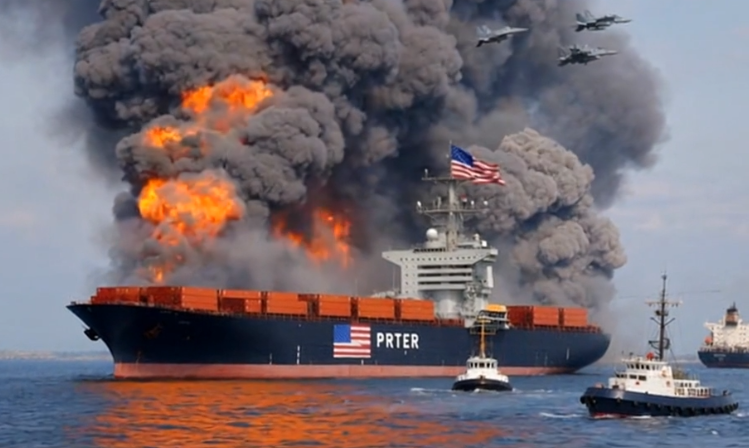
Captain David Reynolds stood on the bridge of the USS Liberty, the most vital cargo ship in the United States fleet. She was no ordinary vessel; she was a floating lifeline, laden with medical supplies, ammunition, and critical electronics destined for allied forces amid rising global tensions. For weeks, the crew had sailed under the shadow of possible conflict between superpowers. Now, on this quiet dawn, the weight of that responsibility pressed heavily on David’s shoulders.
Golden light spilled across the calm ocean as the sun crested the horizon. Yet David felt an unnatural chill in the salt air. The sea, usually a source of solace, seemed restless. He sensed the ghosts of naval legends—those who had faced impossible odds—watching from the edges of memory. History had a way of repeating itself on these waters, and today it felt closer than ever.
The tranquility shattered without warning.
A piercing alarm wailed through the ship’s corridors. Red emergency lights strobed across the bridge as crew members sprinted to their stations, voices overlapping in urgent shouts. The radar operator’s screen erupted in a frenzy of glowing blips—multiple contacts closing at high speed from the northwest.
Lieutenant Sarah Mitchell burst onto the bridge, her dark hair slightly disheveled, eyes sharp with resolve despite the pallor on her face. “Captain! Incoming Russian Su-35 jets—high altitude, supersonic approach. At least four of them!”
David’s stomach tightened. The Su-35s were apex predators of the sky: supermaneuverable, heavily armed, and unforgiving. This was no training exercise or accidental incursion. This was deliberate aggression—a declaration carved in jet fuel and missile contrails.
“Sound general quarters!” he ordered, his voice cutting through the chaos like a blade. “Evasive maneuvers, flank speed! All hands to battle stations!”
The Liberty heeled sharply as the helmsman threw the wheel over, carving white foam through the waves. David gripped the console, feeling every vibration of the aging hull. He had drilled his crew relentlessly for moments like this, but simulations could never replicate the raw fear clawing at his chest. Eighty-three souls depended on him. Each life was a thread in the fragile tapestry of his command. He refused to let it unravel.
High above, at 35,000 feet, Russian pilot Alexei Petrov adjusted his oxygen mask and scanned his heads-up display. The 38-year-old ace had flown for nearly two decades, but today’s mission carried a different gravity. The encrypted order from command had been unambiguous: sink the American supply ship and sever the Western lifeline. For Russia, this was a necessary strike to shift the balance of power. For Alexei, it was the culmination of years of training and quiet patriotism.
“Target acquired,” he murmured into his helmet, voice steady. His thumb hovered, then pressed. The R-77 missile dropped from the pylon and rocketed forward, its engine igniting in a brilliant streak of fire.
On the Liberty’s bridge, David saw the incoming trail of death. Time seemed to stretch and slow. The missile grew from a distant spark to a roaring predator.
“Brace for impact!” he roared, clutching the rail.
The explosion was apocalyptic. A thunderous concussion slammed the ship sideways. David was hurled across the deck, his shoulder slamming into a console. Acrid black smoke poured through ruptured vents. Alarms screamed in a deafening symphony of panic and damage reports.
Struggling to his feet, he shouted, “Damage report!”
Sarah’s hands flew over her station, blood trickling from a cut on her forehead. “Main engine room hit! We’re taking on water fast. Fire in compartments three and four!”
“Get the damage control teams down there,” David ordered. “Prepare lifeboats but hold for my command.”
The ship groaned like a wounded beast as seawater flooded the lower decks. Crew members battled flames with hoses and extinguishers, their faces streaked with sweat and soot. David moved among them, offering steady words even as doubt gnawed at him. He had always believed in the Liberty’s resilience and his crew’s unity. Now the ocean seemed hungry, ready to swallow them whole.
Alexei banked his Su-35 for another pass, adrenaline surging. From his vantage, the cargo ship listed heavily, flames licking skyward. Victory should have tasted sweet. Instead, a flicker of unease stirred. These were not faceless enemies below; they were sailors fighting for survival, just as he would in their place.
“Man the guns! Return fire!” David commanded from the bridge. The Liberty’s defensive batteries roared to life. Tracers arced into the sky in a deadly ballet of light and smoke. For a fleeting moment, hope flared as one jet veered away under pressure.
Then the second missile struck.
The blast ignited fuel stores. Fire raced across the deck like a living thing. Sarah screamed into the radio, “Mayday! Mayday! USS Liberty under attack—” Static swallowed her words.
With the ship mortally wounded and sinking, David made his choice. He could flee with the crew or remain at his post. Loyalty and duty anchored him.
“Abandon ship!” he shouted, voice breaking with emotion. “I’ll hold them off as long as I can!”
As lifeboats dropped into the churning sea, David stood alone on the burning bridge, firing the last operational guns until the heat blistered his hands. In the cockpit above, Alexei watched the lone figure defying the flames. Something human fractured inside him.
He keyed his radio. “Command, this is Petrov. I cannot continue. These are not combatants worth destroying. I request stand-down.”
The order came too late. The USS Liberty slipped beneath the waves in a hiss of steam and sorrow. David’s final thoughts were of his crew—those he had saved, and those he could not.
In the days that followed, the world recoiled in horror. The sinking became a stark emblem of war’s brutality and peace’s fragility. David Reynolds and his crew were remembered as heroes. Alexei Petrov returned to base a victor on paper, yet carried a heavier burden: the knowledge that some victories hollow the soul, and the truest battles are fought not in the sky, but within the conscience of a single man.