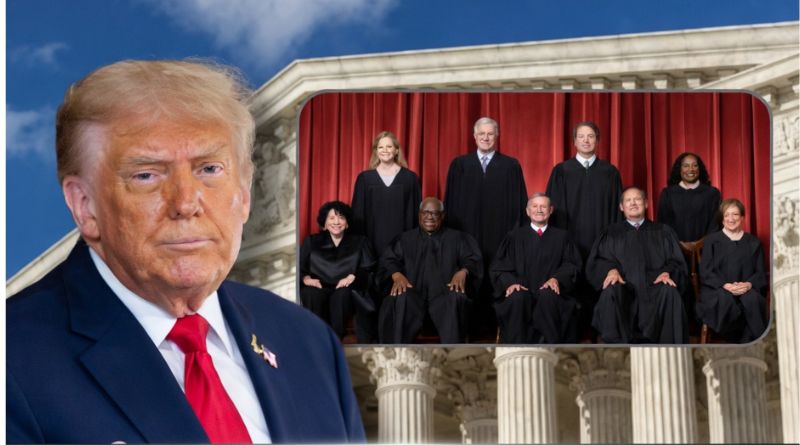
The Supreme Court of the United States has cleared the way for the Trump administration to proceed with the deportation of eight immigrants currently held at a U.S. military base in Djibouti, destined for South Sudan. In an unsigned opinion, the justices affirmed that a previous stay on a lower court’s ruling applies in full, effectively neutralizing efforts by a federal judge in Massachusetts to restrict “third-country” removals. This legal mechanism involves deporting individuals to nations that were not explicitly listed in their initial removal orders, a practice that has sparked intense debate regarding international human rights and administrative authority. The case centers on an ongoing dispute between the executive branch and U.S. District Judge Brian Murphy. In May, Judge Murphy ruled that the federal government could not deport immigrants to third countries without first establishing rigorous safeguards to ensure they would not face torture. He specifically cited the administration’s attempts to send the eight individuals—originally from Cuba, Vietnam, and Laos—to South Sudan as a breach of his judicial orders. The State Department currently advises against all travel to South Sudan due to pervasive “crime, kidnapping, and armed conflict,” highlighting the extreme risks associated with the region.
Representing the government, U.S. Solicitor General D. John Sauer argued forcefully that the district court’s intervention was “wreaking havoc” on the nation’s “sensitive diplomatic, foreign policy, and national-security efforts.” Sauer characterized the lower court’s actions as an “unprecedented defiance” of the Supreme Court’s higher authority. He maintained that the ability to conduct third-country removals is a critical component of immigration enforcement that should not be hampered by “judicially created procedures.” The eight men at the center of this controversy have been detained at a U.S. military post in Djibouti after their initial deportation flight landed there instead of its intended destination. Defense lawyers for the immigrants urged the Supreme Court to uphold Judge Murphy’s injunction, stressing that it did not permanently block deportations but simply required the Trump administration to “follow the law” by ensuring the safety of those being removed. They argued that bypassing these safeguards could lead to irreparable harm for individuals being sent to a war-torn nation.
The Supreme Court’s majority disagreed with the lower court’s persistence, stating that the previous stay on the injunction made the order impossible to enforce. While Justice Elena Kagan sided with the conservative majority on procedural grounds, Justice Sonia Sotomayor and Justice Ketanji Brown Jackson filed a blistering dissent. Sotomayor criticized the court for allowing the government to hand over noncitizens to local authorities in South Sudan “without regard for the likelihood that they will face torture or death.” She further condemned the court’s “continued refusal to justify its extraordinary decisions,” calling the majority’s position on the matter “indefensible.”