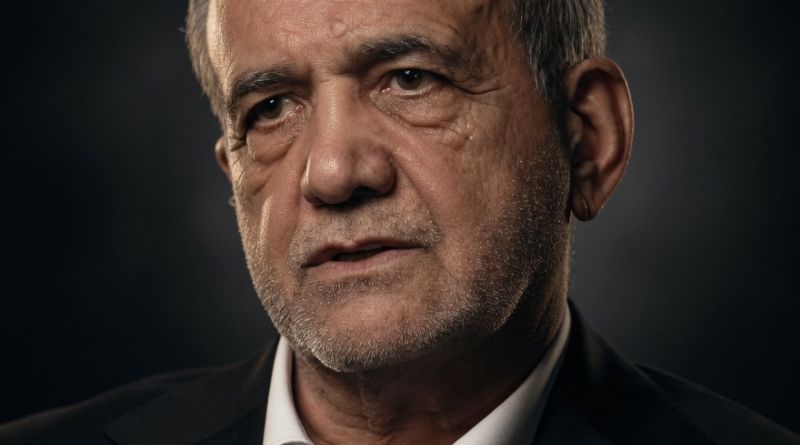
In a dramatic public message released just before former President Donald Trump’s national address, Iran’s president, Masoud Pezeshkian issued a lengthy letter directed not to governments, but directly to the American public. The statement sought to explain Iran’s position amid escalating tensions, reject claims that Tehran represents a direct threat, and place responsibility for worsening instability on Washington’s recent actions.
The letter presents Iran as a nation under pressure rather than an aggressor, arguing that attacks on strategic infrastructure risk consequences that could spread well beyond Iran’s borders. Pezeshkian specifically warned that strikes on energy systems, industrial centers, and key civilian facilities amount to direct pressure on ordinary Iranians and could trigger wider economic and political fallout across the region and beyond.
He argued that such actions are not limited to military consequences. According to the letter, targeting infrastructure damages civilian life, disrupts daily stability, and creates resentment that can last for generations. In his words, attacks on these sectors do not demonstrate strategic strength but instead reveal a failure to pursue durable political solutions.
Much of the letter focused on Iran’s long historical identity. Pezeshkian described Iran as one of the world’s oldest continuous civilizations and emphasized that, despite centuries of external pressure, occupation, and conflict, the country has not chosen expansion or colonial domination in modern history. He claimed that even when Iran possessed military strength relative to nearby states, it did not initiate wars, but instead defended itself when attacked.
The message also attempted to separate governments from ordinary citizens. Pezeshkian stressed that the Iranian people do not hold hostility toward Americans, Europeans, or neighboring populations, arguing that Iranian society traditionally distinguishes between foreign governments and the people living under them. He described that distinction as a deeply rooted cultural principle rather than a temporary political slogan.
A major theme of the letter was the argument that Iran’s image as a global threat has been politically constructed. According to Pezeshkian, powerful nations often require an enemy in order to justify military expansion, arms spending, and strategic control over global markets. In that context, he said, Iran has been repeatedly presented as a danger regardless of historical evidence.
He pointed directly to the heavy U.S. military presence surrounding Iran, arguing that American bases and forces concentrated near Iranian territory create a security environment that naturally pushes Tehran to strengthen its defenses. From Tehran’s perspective, he wrote, Iran’s military posture is a reaction to surrounding threats rather than preparation for offensive war.
The letter also revisited the troubled history between Iran and United States, arguing that relations were not originally hostile. Pezeshkian identified the 1953 Iranian coup d’état as the turning point that created deep mistrust among Iranians. He said the intervention disrupted Iran’s democratic development by removing a government that had sought control over national resources and replacing it with dictatorship.
He continued by pointing to later events that deepened that distrust, including Washington’s support for the Shah, backing for Saddam Hussein during the Iran-Iraq war, and decades of sanctions that Tehran considers among the harshest ever imposed on a nation in modern times.
Despite those pressures, Pezeshkian claimed Iran has strengthened internally. He cited major improvements in literacy, education, healthcare, and infrastructure, saying the country’s literacy rate has risen from roughly one-third of the population before the Islamic Revolution to more than ninety percent today. He also pointed to advances in science, technology, and university development as evidence that sanctions and external pressure have not prevented national progress.
Still, he acknowledged that sanctions and military threats have imposed severe burdens on daily life. The letter argued that repeated attacks and economic restrictions affect not only material conditions but also public attitudes. According to Pezeshkian, when civilians experience destruction of homes, industry, and long-term economic hardship, it becomes impossible to expect neutrality toward those seen as responsible.
He then raised a series of direct questions aimed at Americans: whose interests are actually served by military confrontation with Iran, and whether any objective threat truly justifies such escalation. He argued that bombing civilian-linked facilities—including pharmaceutical production connected to cancer treatment—damages America’s global reputation more than it advances security.
The letter also returned to the issue of diplomacy. Pezeshkian said Iran entered negotiations in good faith, accepted agreements, and fulfilled commitments, while the U.S. later chose withdrawal and renewed confrontation. Though he did not name the agreement directly, the reference clearly pointed to the Joint Comprehensive Plan of Action, which became a central source of tension after Washington exited the arrangement.
One of the strongest sections accused the U.S. of acting indirectly on behalf of Israel. Pezeshkian argued that Israeli leadership has exaggerated the Iranian threat to shift international focus away from the Palestinian issue and draw Washington deeper into regional conflict. He suggested that American military and financial resources are being used to serve another government’s strategic priorities rather than genuine U.S. interests.
He framed this as contradictory to the slogan “America First,” asking whether current decisions truly reflect the priorities of ordinary American citizens.
Toward the end of the letter, Pezeshkian appealed directly for Americans to question what he called misinformation surrounding Iran. He encouraged readers to speak with visitors who have been to Iran and to consider the role of highly educated Iranian immigrants who now work in Western universities, research centers, and advanced technology companies. In his view, those realities contradict portrayals of Iran as a society defined solely by hostility or extremism.
The closing message cast the current moment as a major turning point. Pezeshkian argued that continued confrontation would produce rising costs with diminishing returns, while engagement still offers a path to long-term stability. He framed the decision as one that will influence future generations.
He ended with a historical reminder: many powers have confronted Iran over centuries, he wrote, yet those powers faded while Iran remained. The implication was clear—Tehran sees endurance itself as proof that pressure and aggression will not break the country’s identity or political resolve.