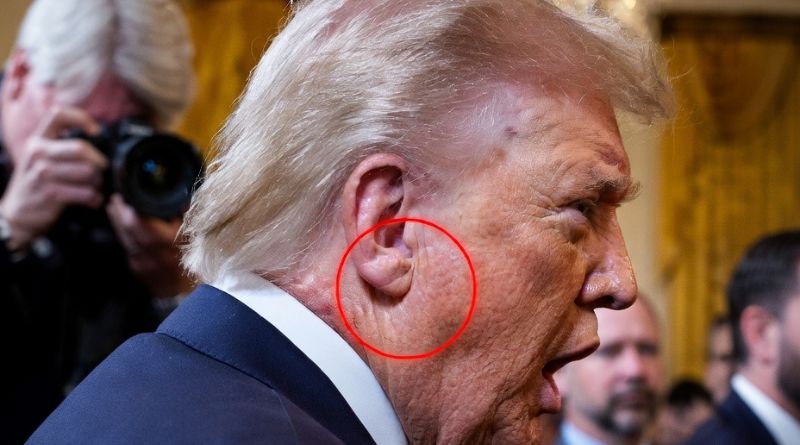
Images from a recent Medal of Honor ceremony quickly drew public attention after a small mark on the 79-year-old president’s skin became visible in photographs. What seemed at first like a minor skin irritation soon sparked widespread discussion online, with many people questioning whether it reflected a larger health concern. To address the growing speculation, Dr. Sean Barbabella stated that the mark was the result of a simple “preventative skin treatment,” emphasizing that it was routine and not linked to any serious medical issue. Even with that explanation, the images continued to circulate widely across social media platforms 📸.
In recent months, the president’s public appearances have been examined in unusual detail. Small physical signs such as a bruise, a brief hesitation while speaking, or moments of visible fatigue often become talking points in political conversations. During this ceremony, commentators once again closely reviewed photographs and video clips, searching for clues about his condition. Political analyst David Pakman pointed to a faint crease on the president’s earlobe, mentioning that some medical studies have loosely connected such features with cardiovascular risk, while also noting that the scientific evidence remains uncertain and heavily debated.
The discussion reflects a broader challenge in modern politics: balancing official reassurance with public skepticism. In an era shaped by nonstop media coverage and instant online reactions, even minor visual details can quickly take on larger meaning. A small mark, pause, or expression may become part of a wider conversation about leadership, transparency, and public trust 📰⚖️.