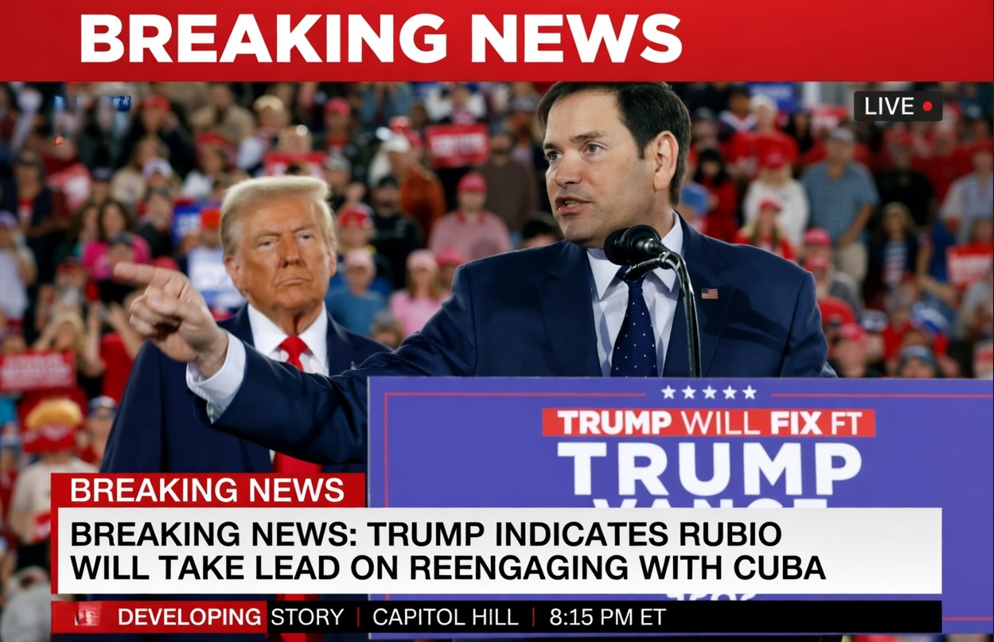
President Donald Trump has signaled a pivotal turning point in American foreign policy by suggesting that the United States is moving toward a formal reengagement with the government of Cuba. This announcement marks a transition from a stance of pure isolation to one of active negotiation, though the President maintained that the current regime in Havana is on its “last legs.” A central figure in this unfolding diplomatic drama is Secretary of State Marco Rubio, whom Trump has designated to lead the effort. Rubio’s appointment is viewed as both symbolic and strategic, given his Cuban heritage and his long-standing opposition to the island’s communist leadership. In recent remarks, the President offered high praise for Marco Rubio, predicting he would eventually be remembered as “the greatest Secretary of State in history.” Trump highlighted Rubio’s linguistic capabilities and his deep understanding of the region’s cultural nuances as essential tools for the upcoming negotiations. The President’s vision for Cuba remains flexible yet firm, alternating between the prospect of a “friendly takeover” and a negotiated settlement. Trump noted that the specific method of transition might ultimately be irrelevant because the Cuban government is currently “down to fumes,” lacking the financial resources, energy supplies, and political momentum required to sustain its current form. The economic desperation of the island was a recurring theme in the President’s assessment of the geopolitical landscape. He traced the regime’s current vulnerability back to the collapse of its partnership with Venezuela. Historically, the Castro regime relied heavily on Caracas for fuel and financial subsidies. However, following a series of U.S.-led interventions in Venezuela—which reportedly included the capture of Nicolas Maduro—that support system has effectively vanished. Without the oil, fuel, or money provided by their former allies, and under the weight of U.S. sanctions, Trump argued that the communist leadership has no viable path forward other than to strike a deal with the United States.
Trump also framed the issue within the context of domestic politics and the Cuban American experience. Speaking at the Shield of the Americas summit held at his property in Doral, Florida, the President reflected on the “hell” that many families endured under the “brutal” Castro regime. He acknowledged the immense success of the Cuban American business community and credited them with being a vital part of his political coalition. By prioritizing the “great change” in Cuba, Trump is directly addressing the concerns of a constituency that gave him “record levels” of support, promising that their long wait for a transformation of their ancestral homeland is nearing its conclusion. The timeline for this transition appears to be moving rapidly according to the administration. Trump confirmed that Cuba is already in the process of “negotiating” with Marco Rubio, and he expressed confidence that a resolution could be reached quickly. This proactive stance toward Cuba is presented as part of a broader administrative strategy following what Trump described as a “historic transformation” in Venezuela. As the administration looks to secure the Western Hemisphere, the President’s rhetoric suggests that the fall of the existing system in Cuba is an imminent reality. The ultimate goal, according to the President, is to usher in a “great new life” for the island, ending decades of hardship and economic stagnation.