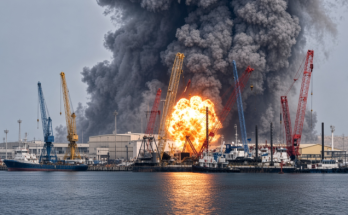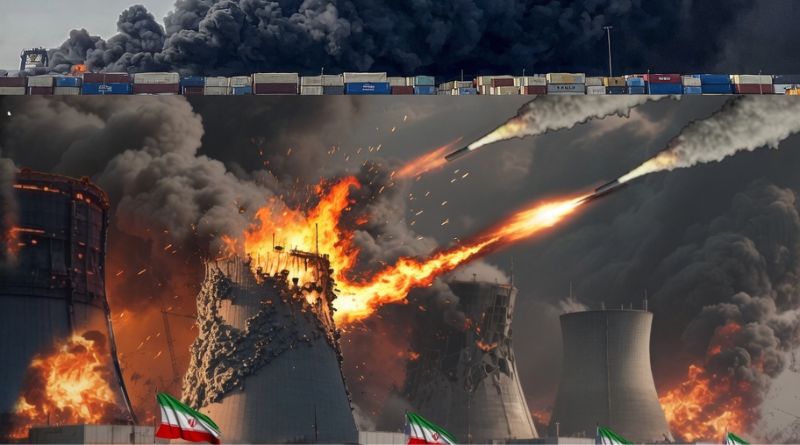
The most dangerous headlines often arrive fully formed, pulsing with the weight of fact. They don’t ask permission; they storm in, armed with dramatic wording and unshakeable certainty, challenging the world to keep pace. That’s precisely how the latest viral claim exploded: a U.S. intercontinental ballistic missile had obliterated an Iranian nuclear facility in Tehran, placing the Iranian capital at the epicenter of a cataclysmic blast. It was the kind of moment engineered not just to inform, but to stun.
Yet the unfolding reality in Iran proves both more grounded and more unsettling than the sensational version. No major credible outlets have verified evidence that the United States launched an intercontinental ballistic missile (ICBM) in the manner the headline implied. What is confirmed remains profoundly serious, capable of rattling governments, markets, armed forces, and ordinary citizens who have watched the Middle East shift from familiar crisis rhetoric to the lexicon of prolonged war.
The conflict—drawing in Donald Trump’s United States, Iran, Israel, and an expanding network of regional players—has already breached thresholds once deemed too expensive to cross. It erupted on February 28, 2026, with coordinated U.S. and Israeli strikes on Iranian targets, including leadership, military infrastructure, and elements of the nuclear and missile programs. The confrontation has since broadened into sustained exchanges of missiles, infrastructure assaults, threats to critical energy corridors like the Strait of Hormuz, and widespread economic disruption no longer limited to the battlefield.
Viral myths thrive where truth is already fractured. And the current reality is fractured enough. On April 1, President Trump told Reuters the U.S. would exit Iran “pretty quickly” but reserved the right to return for targeted “spot hits” if necessary. He also suggested Iran’s leadership had undergone violent transformation amid the fighting. That alone reflects the feverish pitch of the moment.
This is no longer solely a contest of deterrence. It has evolved into a brutal test of endurance, escalation ladders, and narrative control—waged through physical strikes, energy chokepoints, political symbolism, and the volatile terrain of public perception.
The viral headline’s allure is straightforward: it delivers one crisp, apocalyptic image—a single thunderous act that resolves everything in a flash. Real modern warfare rarely cooperates with such cinematic simplicity. It unfolds in messy layers: the initial strike, the fog of confusion, rival storylines, the evidence that endures scrutiny, and ultimately the colder truths that outlast the initial roar.
Reliable reporting confirms Tehran has faced mounting pressure as the conflict intensified. Israel conducted waves of attacks, with Tehran among affected areas. The war, now well into its second month, has sparked fears of broader retaliation, driven oil prices sharply higher, and left no immediate off-ramp in sight. Trump has publicly vowed intensified action in coming weeks, statements that amplified anxiety in financial and diplomatic circles.
Concerns surrounding Iran’s nuclear infrastructure are real but nuanced. Satellite imagery and Iranian statements have indicated strikes on sites like Natanz, a key uranium enrichment facility. The International Atomic Energy Agency (IAEA) has monitored developments, noting in some cases no immediate signs of the total destruction claimed in early reports, while confirming access to certain unaffected areas. Iran’s program is geographically dispersed, deeply layered, and protected in ways that defy any single “decisive blow” narrative—whether in Tehran or elsewhere.
This is where the viral claim fractures. Intercontinental ballistic missiles occupy a rarefied strategic realm, primarily tied to nuclear deterrence and existential escalation. Deploying one for a conventional strike, especially without ironclad public confirmation, crosses into misleading territory. The irony cuts deep: the actual war requires no embellishment to terrify. It is authoring its own nightmare.
Reports indicate that only a portion of Iran’s missile capabilities has been verifiably neutralized, with significant assets potentially intact in underground facilities. The adversary retains teeth. Meanwhile, the conflict radiates outward. Pakistan, Turkey, and Egypt have positioned themselves as potential mediators. Iran has warned of fierce resistance to any ground incursion. These are not the mechanics of a concluded operation but of a region scrambling to contain a fire that has already breached multiple containment lines.
Economically, the strain is unmistakable and often the clearest early signal of seriousness. Hopes for a rapid resolution faded as Trump signaled prolonged or intensified efforts, sending Brent crude surging amid fears over the Strait of Hormuz—a vital artery for global oil flows. Markets do not panic over fiction; they react to tangible pressure on real systems.
Tehran itself holds outsized symbolic weight. As Iran’s administrative, psychological, and political heart, any reported major strike there reverberates far beyond its military value. Even overstated claims draw oxygen from very plausible underlying fears. This is the core tragedy of information warfare in the digital age: verified dangers create the breach through which exaggeration floods.
Responsible assessment must hold the line. Iran faces extraordinary military pressure. Nuclear-related sites remain under scrutiny and, in documented cases, attack. Its leadership and infrastructure have been directly threatened by the U.S. and Israel. Tehran sits at the emotional core of the narrative. Mediators are active. Oil prices are climbing. Trump’s statements point to possible harsher measures ahead. That inventory is already electric—sufficient to render every rumor more flammable.
Iran’s nuclear architecture is not a lone urban bullseye. Facilities like Natanz are separated, hardened, and complex; accurate damage assessment demands time, imagery, inspections, and restraint—not instantaneous certainty from a single lurid post.
The deeper truth transcends any one claim. The world is witnessing a threshold moment where military action, political signaling, and instantaneous digital virality slam together in real time. A headline can girdle the globe before satellites finish their pass. Markets can lurch before agencies confirm details. A capital can be declared crippled before the dust settles. Perception itself has become a theater of operations.
For ordinary Iranians, the gap between fact and hype offers little comfort. Families in Tehran need no ICBM to sense the altered sky. The accumulating weight of warnings, sounds, and possibilities is exhausting enough. One unverified headline simply piles atop many verified threats.
In Washington, messaging blends force with strategic ambiguity. Trump has employed maximalist language about crippling Iran and dictating terms, while signals of back-channel talks and pressure for a swift close persist. That tension reveals a campaign still defining its endpoint even as its tone hardens.
The real shock is not a single impossible missile erasing a Tehran nuclear site. It is that the verified war has grown intense enough for such a claim to land instantly as plausible. Iran’s conflict is widening. Tehran endures layered pressure. Nuclear sites stay vulnerable. Diplomacy races. Oil climbs. Threats multiply. The buffer between events and imagination is evaporating.
This is the story that holds: not fantasy apocalypse, but a volatile reality where fact and fiction increasingly arrive cloaked in the same smoke. Responsible journalism does not fan panic. It insists on proportion—distinguishing confirmed impacts from dramatic invention. In doing so, it defends clarity, one of the final bulwarks war seeks to erode.
Right now, clarity records an expanding war, documented strikes, pressure on Tehran and nuclear infrastructure, mediation attempts, economic shocks, and public threats of further U.S. action. It does not record the precise viral scenario of an ICBM destroying a nuclear facility in Tehran. That distinction is not trivial. It is the boundary between journalism and adrenaline. In times like these, preserving it may be among the public’s last safeguards against fear drafting reality before evidence arrives.